
My mother always said things come in threes. Some might call it superstition or coincidence or the result of energy following the mind’s focus. But more often than not, things in threes seemed to happen.
And so it did when I arrived at Hervey Bay, the third stop in our road trip. Over the ten days, we’d visited the Brisbane Valley Rail Trail near Esk. Around Bargara, we’d seen the sugar cane locos shuffling around the cane fields. Then arriving at Hervey Bay where calm seas floated like pale blue silk, my bicycle gave me yet another railway encounter.
This time it was the ghost of a railway.
Stretching out into the bay waters for almost a kilometre, The Urangan Pier is a prominent feature in Hervey Bay. When it was built in 1917, the pier was even longer at 1124 metres. Steam trains carrying sugar, coal and timber would clatter along the pier delivering their load to cargo ships. This railway line remained active until the 1980s.
Now its grey hardwood boards carry people out to sea. Some stroll, some walk briskly, some run, others fish or take photos or pause to look over the stark white railing for a glimpse of passing sting-rays, dolphins, bream or tuna. And some, like me, well they ride a bike along the pier.
So I thought I’d take you for ‘a dink’ with me. Or perhaps you know it as ‘a double’. Or perhaps you have no idea what I mean. To ‘dink’ or to ‘double’ is an Australian expression for giving someone a lift on a bicycle. So click the video and hop on 🙂
It’s a five minute ride, quite beautiful but it might be a bit bumpy or a bit long (it is almost a kilometre). So hop off whenever you like 🙂
If you’d like to read more from this series of road trip stories, follow these links. The first story is about my first experience of the Brisbane Valley Rail Trail. In the second story, I write about riding the Brisbane Valley Rail Trail unsupported – you just never know who you’ll meet. The third story takes me to Bundaberg for some sugar cane cycles and my fourth story celebrates the streets of small towns.
With campervan packed and bikes loaded on the back, we went travelling old roads with new eyes. This is the fourth story from my recent road trip in South East Queensland.
It was a Monday morning and we rode inland along Bargara Road. Week days bring out the life of a town. You see its workings more clearly – who does what and when, how things get done. Of course, it’s only a glimpse but sometimes that small insight lends itself to something bigger, a broader character supported by the town.
Turning right at Bargara State School, I saw a long straight of bitumen stretching to Qunaba Sugar Mill in the distance. Winter’s cool wind was on our tail. The sun yet to peek over the paperbarks trees and spill onto the sugar cane fields. We rode briskly.
Up ahead I saw a flashing yellow light. The type you get on garbage collection trucks which would’ve made sense because we were nearing the local garbage dump (or waste disposal centre as they’re now known). But this yellow light was flashing beside the sugar cane.
It belonged to a small left hand drive buggy driven by a bulky man wearing a full faced motorbike helmet. He was motoring slowly along the edge of the cane field. We exchanged waves and I wondered what he was doing. He didn’t look like a farmer.
The end of the road brought an t-intersection and some extremely tall cane catching the sunlight. We pulled over to take some photos. Before long, Buggy Man motored in and we got chatting. He works for the council and each day drives his buggy around the dump’s perimeter collecting stray rubbish – papers and plastics – blown out of the compound. I look around and notice the litter flung by the wind into the wire fence. The cold weather was making his job more difficult than usual because his windscreen was awash with morning dew and the buggy has no windscreen wipers.
He’s curious about us too. Two women standing on the side of a sugar cane paddock on a cold winter morning taking photos of bicycles, sugar cane and sunshine. So we chat some more, then ride on to Mon Repos, through the Barolin Nature Reserve and onto Neilsen Park.
I hear drumming. Djembe drumming. My heart lifts a beat. I follow it like a siren.
Tucked around the front of the surf club, beside a tall pandanus, a circle of eleven, sit in the sunshine, drumming. I look from a distance. I don’t want to disturb them. I want to enjoy their rhythm.
They’re rugged up in fleeces, a few wear beanies, many grey hair.
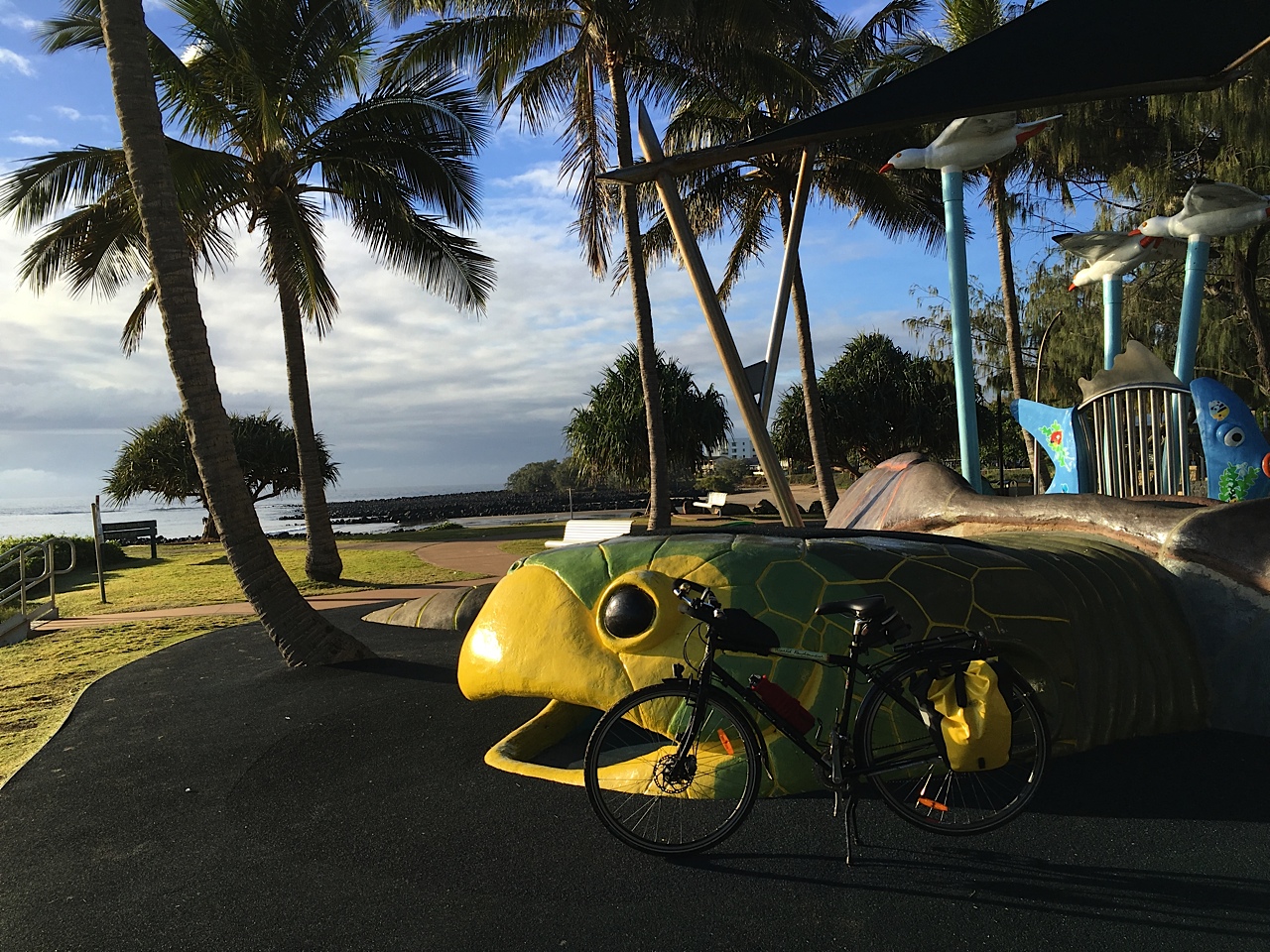
Dosed up on rhythm we ride along the esplanade with its border of round basalt rocks and pull up at the turtle playground. ‘Do you want any bush lemons?’
Three women sit on a small brick wall with a white bucket. They’ve been walking. They’re the heart foundation ladies who meet each morning to walk. One of the ladies, she’s left now, brought the bucket full of lemons from her backyard tree. There’s four there. Have them all. And so we did.
Interesting people dot the streets of small towns. It’s not their celebrity status that makes them interesting or how many ‘likes’ they have on Facebook. Their choices make them interesting. Their choices about the work they do, the talents they explore, the generous spirit they share.
If you’d like to read more from this series of road trip stories, follow these links. The first story is about my first experience of the Brisbane Valley Rail Trail. In the second story, I write about riding the Brisbane Valley Rail Trail unsupported – you just never know who you’ll meet. The third story takes us to Bundaberg and some sugar cane cycles.
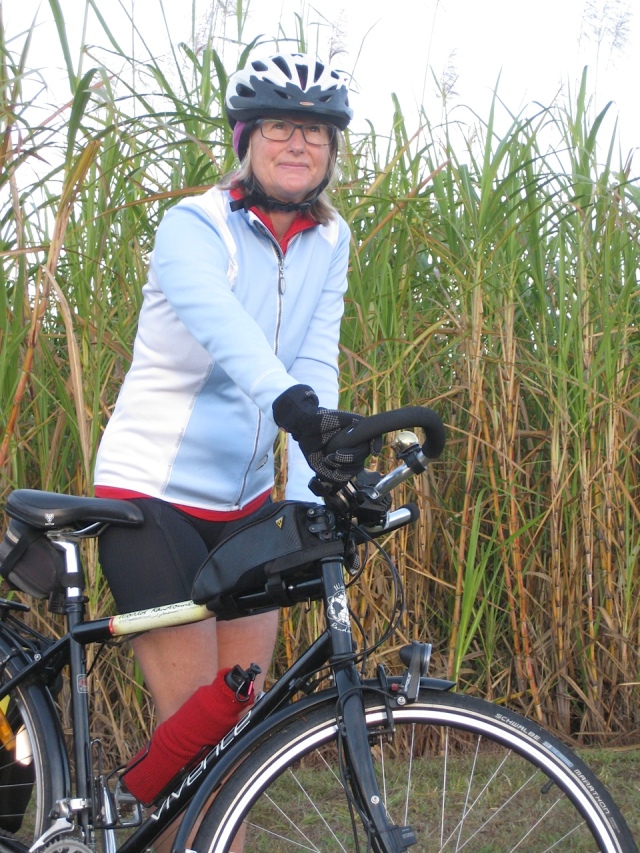
Sugar cane cyclist
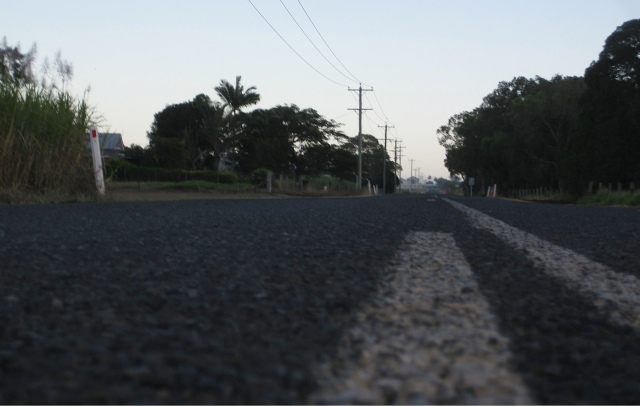
Long stretch of bitumen heading to Qunaba Mill
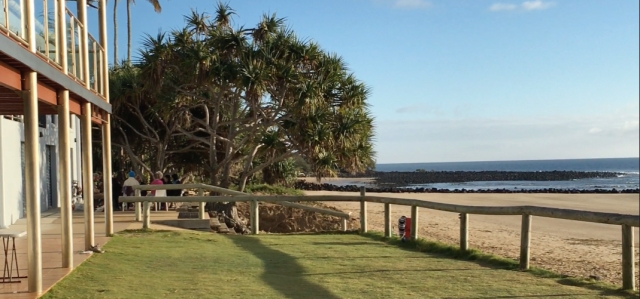
Djembe drummers nestled in front of the surf club
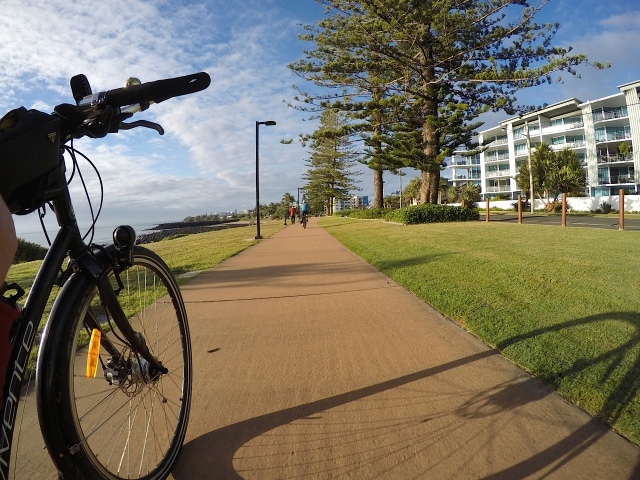
Riding the esplanade at Bargara

Basalt rocks border Bargara’s esplanade.
This is the third in a series of stories from my recent road trip in South East Queensland. With campervan packed and bikes loaded on the back, we went travelling old roads with new eyes.
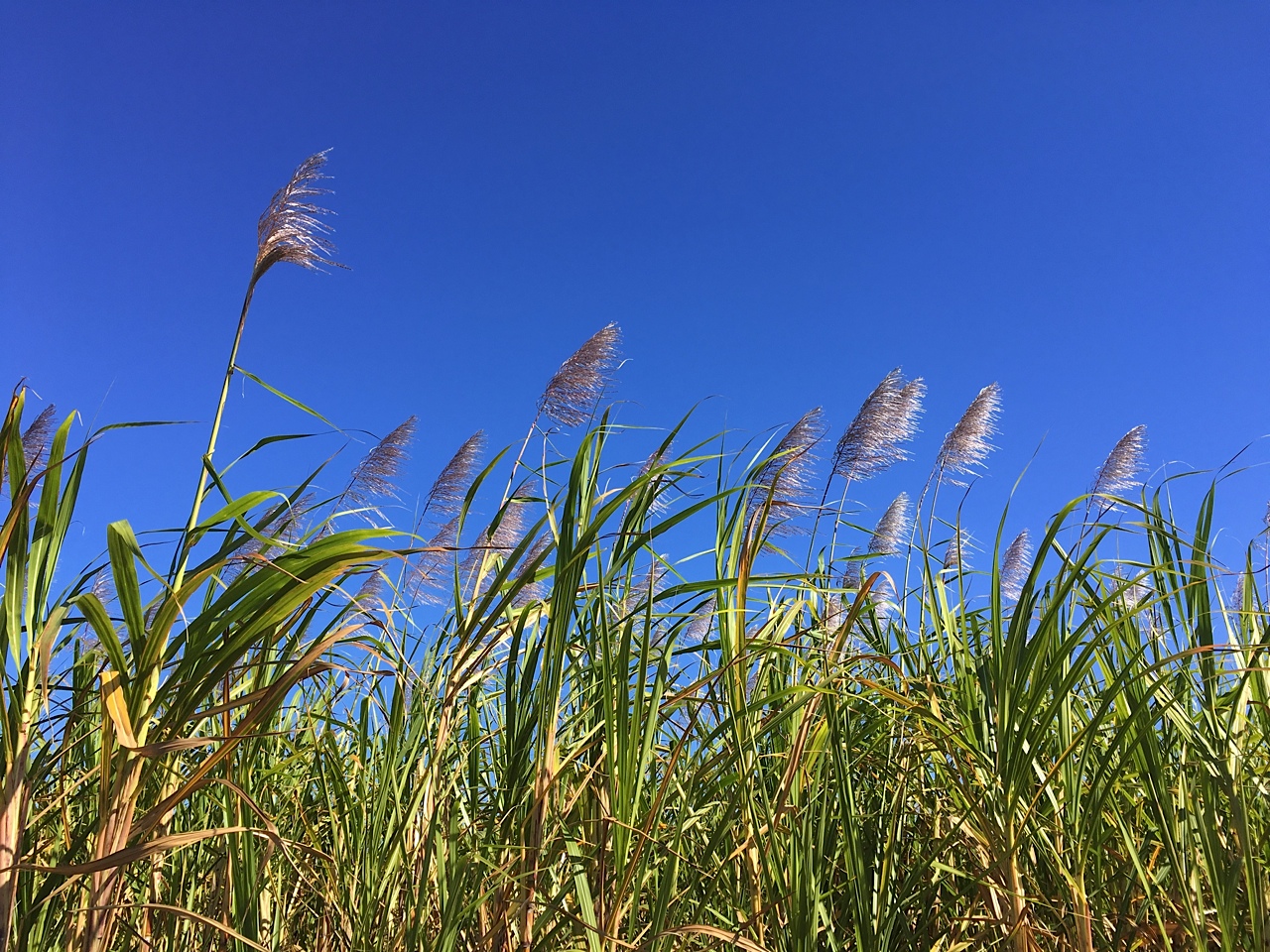
It had been over a year since I cycled through the canefields while visiting Bargara. That was autumn. Now it was winter. The air was colder. The sun rose later. The roads were lined with tall sugar cane reaching to the sky with a flourish of flowers.
I was amazed to see so many flowers. They were prolific. It felt like years since I’d seen the cane flowers and wondered if perhaps our visits were rarely timed in July? But it seems the locals had noticed them too; so it wasn’t my absence but rather the sugarcane’s extra flourish that was the reason.
Flowering in sugar cane depends on the genetic variety. Some flower. Some don’t. And for those that do flower, how much daylight they receive and temperatures, rain and soil nutrition, all influence their flowering. So every year can be quite different.
I love the flowers with their soft feather-like strands, fanning out at the end of a long arrow. The flowers sway in the sea breezes against blue winter skies. They tell me the annual crushing is near.
And when I was young and living on a sugar cane farm, this meant there would be cane fires – at dusk, at night. The wind needed to be right, hoses needed to be ready, and buckets too. Neighbouring farmers would gather to manage the fire, knowing this help would be reciprocated when their crop was ready to burn. This was the sixties when farms were smaller and hadn’t yet become agri-businesses.
Burning sugar cane before harvesting was then commonplace. Now, harvesting the cane green is more typical. It’s better for the environment, removing all that smoke and soot from the air. But this leaves me conflicted because to see a cane fire – its magnificence, its power – is to see something quite beautiful. It is a sight that mesmerises. It carries a scent forever sweet. A sound that roars.
I saw remnants of the cane fires while riding my bicycle along the roads. I saw the train tracks for the locos – the locomotive engines – that haul wire ‘bins’ of sugar cane to the mills for crushing. I smelt the sweet sugars hanging in the air. I watched the arrows wave their soft tassels. I listened to the cane leaves rustling and began to wonder how this place, that once was home, settles in my bones.


 a bike for all seasons