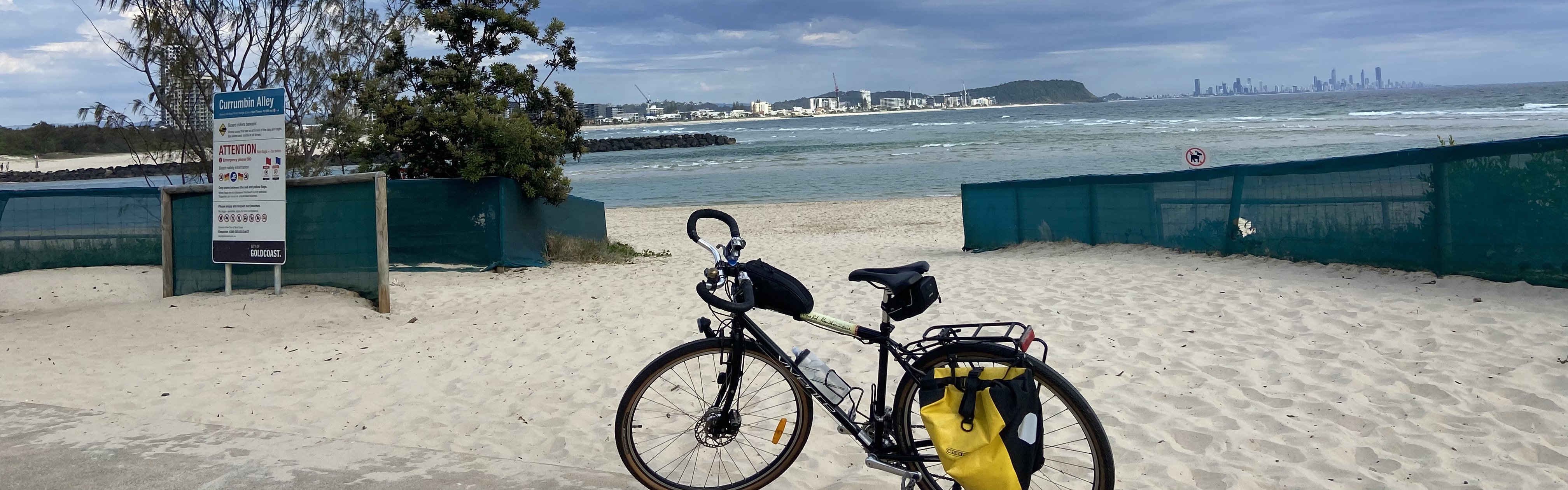
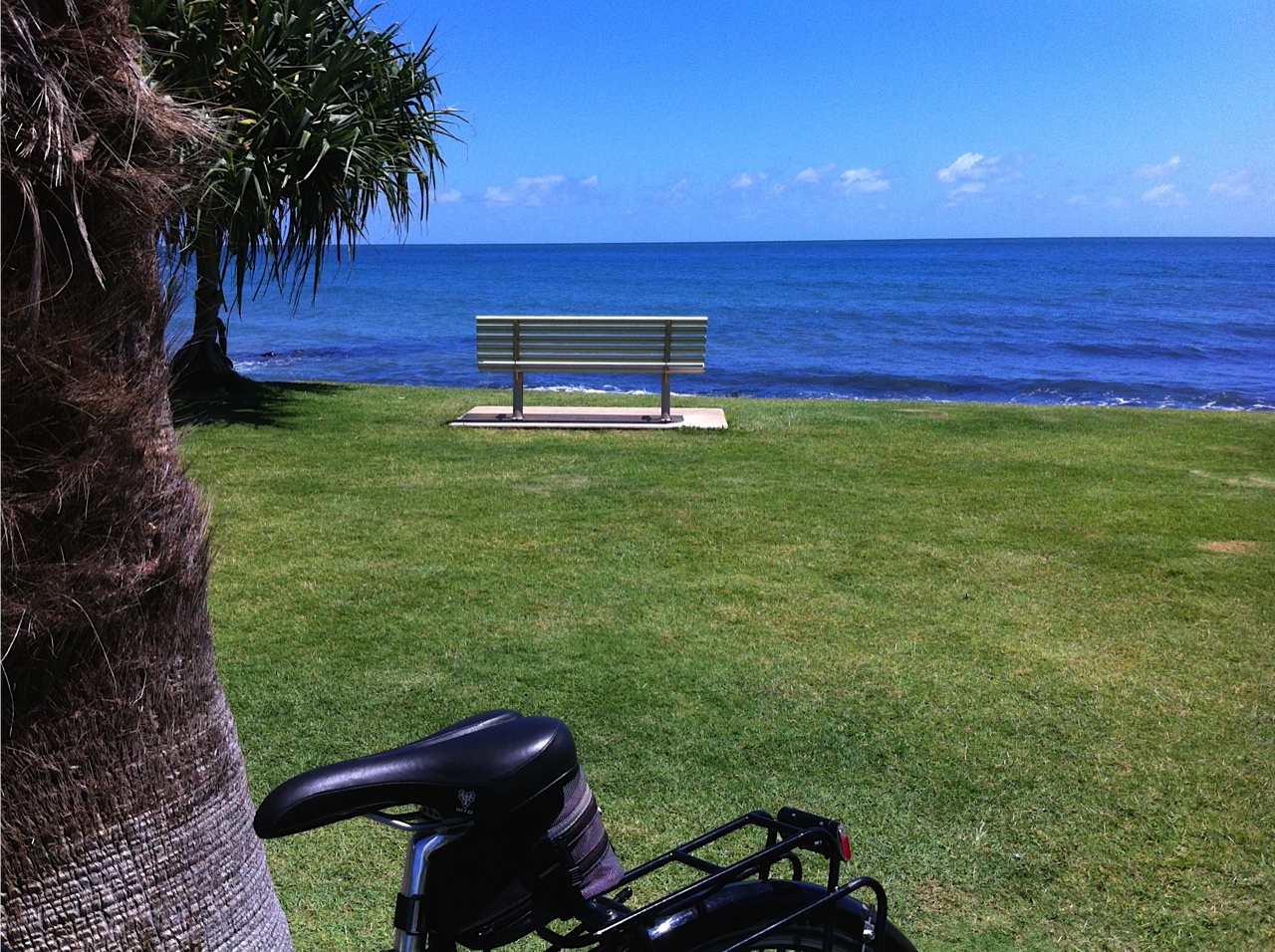
Travelling over Christmas took me to Bargara. This small town hugs a coastline scattered with basalt rocks, remnants of a long extinct volcano, and nestles into the broader reach of the regional city of Bundaberg, which sits twelve kilometres inland. Two years ago, Bundaberg was a focal point of news services across the world because of the destruction and dislocation caused by floods. The city and its coastline is newsworthy for another reason. It is where the Great Barrier Reef begins.
People typically associate Cairns, Port Douglas or the Whitsunday Islands with the Great Barrier Reef. Yet these areas represent only about ten percent of the Great Barrier Reef Marine Park. The Great Barrier Reef stretches for 2300 kilometres along Australia’s east coast. In his compelling account of twelve extraordinary tales about this iconic natural wonder, Iain McCalman (1) estimates the Great Barrier Reef is about the size of England and Ireland together. It extends to the very tip of Cape York in the north and in the south, well that’s why I’m writing. Its southern gateway lies off the coast from Bargara. So when I rode my bike along the Coral Coast Pathway on Christmas Eve, the view from my handlebars was the Coral Sea where the Great Barrier Reef begins.
The Coral Coast Pathway is a shared way for pedestrians and cyclists. I set off from Kelly’s Beach at Bargara and road to Burnett Heads at the tip of the Burnett River. The return trip is twenty-one kilometres. It’s a beautiful ride. The best thing about riding in Bundaberg is that it’s flat. There’s only one hill to elevate the landscape and that’s the remains of the extinct volcano known as the The Hummock. The rest is flat with only a few gentle climbs.
The Coral Coast Pathway meanders along the esplanade parks that edge the foreshore at Bargara and then turns inland for a moment, passing through a stretch of melaleuca trees. It opens up to a grassed paddock where twelve months earlier in 2013, I saw a mob of kangaroos grazing in the late afternoon. This time I rode mid-morning and with the hot weather, I suspect the mob were probably lazing under a shady tree somewhere until the sun softened later in the day.
There is a little bridge to traverse the salt marsh wetland which, on the way out, was a collection of random puddles and, with the incoming tide, later turned into a fully-fledged waterway.
Along the path there is also a turtle rookery known as Mon Repos. What’s a place in a regional Queensland doing with a French name? In the late 1800s a telegraph cable from French Caledonia was laid across the Coral Sea and this area is where the cable touched the Queensland coastline. The testing house for the cable adjoined a homestead owned by a pioneer of the local sugar industry, Mr A.P. Barton. He named his homestead Mon Repos – “My Rest”.
As for the turtles that touch the coast at Mon Repos, there is no rest for them. They arrive on the grainy sands every year to lay their eggs each night between November and February to audiences from all around the world.
The Coral Coast Pathway meanders around the Mon Repos Conservation Park – past waterholes where choruses of cicadas fill your ears and stop you from talking; it winds through the coastal casuarina trees and behind the sand dunes where the turtles make their nests. You just have to follow the turtle markers.
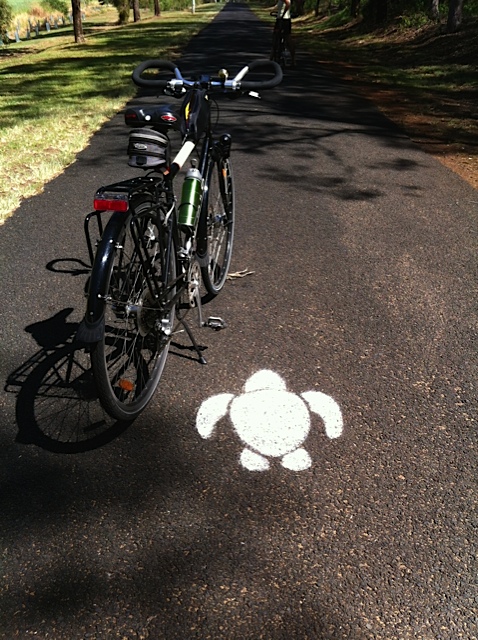
Follow the turtles at Mon Repos
The Coral Coast Pathway is a really enjoyable bike ride. It has a variety of landscape, beautiful birds and the presence of the turtle rookery reminds me of the magnificent reef that starts just beyond these shores.
I don’t want to imagine a world without the magnificent beauty of the Great Barrier Reef.
1. If you are interested in knowing more about the Great Barrier Reef, I recommend Iain McCalman’s book: McCalman, I. (2013). The Reef: A Passionate History. Penguin: Melbourne, Australia.
2. Unfortunately, this magnificent natural wonder that we know as the Great Barrier Reef is threatened by the ever-increasing development of mega-ports for coal mining. The world’s largest coal port has been approved for a site only fifty kilometres from the Whitsunday Islands. For more information follow this link to The Australian Marine Conservation Society.
If you enjoyed this story, click ‘Yes email me new stories‘ and receive my stories straight into your email inbox 🙂 If you know other people who might enjoy it, use the icons below to share it with them on Twitter, Facebook, Pinterest, Google+, LinkedIn or via email. You can also read the About page to find out how this bike riding experiment began and why I’m doing it.

I’m riding in the rain 🎶
Just riding in the rain 🎶
What a glorious feelin’ 🎶
I’m hap..hap…happy again 🎶
About 112mm of rain has fallen since 9am this morning. With a waterproof jacket and curiosity to see what’s happening out there, I ventured out to ride under today’s rainy blanket. Creeks and lakes are swollen. Gutters brimming with water rushing to find the storm water drains. Paths filled with puddles. The fresh rain falling on my face. I’ve enjoyed riding out in the rain today. Particularly knowing there’s a warm cup of tea waiting at home.

Waterways overflowing
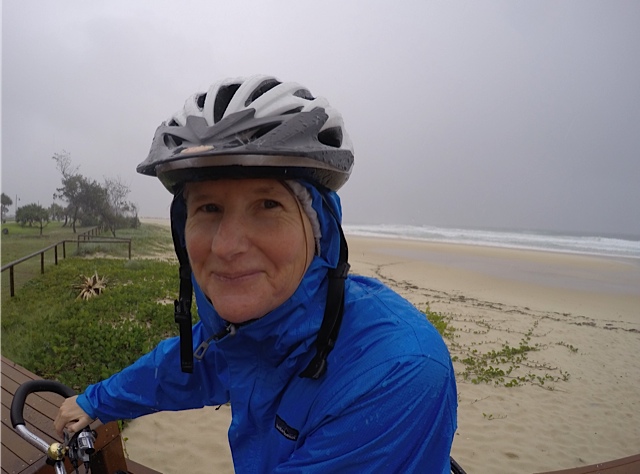
Riding in the rain

Paths filled with puddles

We agreed to meet our friends late Sunday afternoon at their apartment at Main Beach. I figured that if they’ve travelled 36 hours on a plane from New York, then my riding twenty kilometres up the road to Main Beach is only fair.
Though, as Sunday approached, my apprehension grew. Each day, the heat and humidity was intensifying. Thunderstorms were brewing. They were forecast for Sunday. That’s the other question that comes up in my mind these days. “Will the weather let me ride?”
I’ve missed yoga classes because an afternoon thunderstorm made it unsafe to ride. Perhaps this Sunday was going to be the same. I just had to wait until Sunday came. That’s one of the good things about this experiment; it engenders greater presence in the day. The unique rhythm of each day overrides the preconceived plans that ‘thought’ had mapped out for me.
The unique rhythm of each day overrides the preconceived plans that ‘thought’ had mapped out.
The temperatures were rising. Most conversations began with some comment about the weather being so hot. I had two meetings organised in Brisbane for Saturday and travelled there by bus and train. Perspiration becomes your friend in this type of weather. It has to. There’s really no way to avoid it if you have to move around. So does an umbrella and that’s what I used for shade as I walked across the Victoria Bridge just after midday.
After sitting in air-conditioning for a couple of hours, the heat was tangible and reflected back up at me from the concrete and bitumen beneath my feet. Despite walking quite slowly, I started to feel weakened by the intensity of the surround heat. I focused on my breath, slowed my pace even a little more, sensitized my skin to the breeze and let my perspiration do its best to cool me. I felt relieved to find shade under a tree while I waited for the pedestrian lights to change on the other side of the bridge. This was an uncomfortable feeling and added to the disquiet I had about riding the next day.
Sunday arrived. The humidity was in the nineties. I was wearing some residual tiredness from the past week. A debate was sloshing around in my mind: I was thinking of not riding. Was I being a wimp or was it wise not to ride?
At some point, it looked like the thunderstorm might break early in the day leaving the afternoon clearer and cooler. That didn’t happen.
I felt very disappointed at the prospect of not cycling. I had to make a decision. Do I ride?
If we were to ride, we’d need to leave in thirty minutes. I went onto the verandah and sat in the cane chair. There was a light breeze from the east-south-east; a slight tailwind, I thought. I looked at the gum trees, watched the birds, in the hope that some clear direction would land on me, seep up from my insides to switch on the light.
Then it did.
Which story would I prefer to tell?
During my Masters research, I learnt about making decisions that align with my values. An everyday gauge that works every time is this: “Would I be comfortable seeing my choice reported on the evening news?” I guess the digital equivalent is: “would I be comfortable reading it on my news app?”
Now, do I ride or not is hardly newsworthy, nor is it a matter of being ethical or not ethical. However, it is about aligning with the values inherent in this project, where it’s possible.
So did I ride? Yes! It took seventy-one minutes to get there.
Was it hot? You bet it was. Sunday’s minimum temperature was 25.3 degrees, the highest minimum recorded for the month. Officially, the day’s maximum was 34 degrees but along the way we encountered much hotter temperatures than that.
We arrived at Main Beach red-faced and sweaty even after taking a quick swim to cool off and change clothes.
After warm, sticky greetings, our friends swept us into the refreshingly cool air of their holiday high-rise apartment with a spectacular view of the Pacific Ocean, affectionately exclaimed “you’re nuts” for riding in 34 degree heat and 96% humidity, then poured tumblers of iced water and glasses of a very chilled Cloudy Bay Sauvignon Blanc to toast our friendship.
Two and half hours later, the night air carried us home with skies clear and hearts bright.
And the thunderstorm? Well, it never arrived.
If you enjoyed this story, click ‘Yes email me new stories‘ and receive my posts straight into your email inbox 🙂 If you know other people who might enjoy it, use the icons below to share this story with them on Twitter, Facebook, Pinterest, Google+, LinkedIn or via email. You can also read the About page to find out how this bike riding experiment began and why I’m doing it.
 a bike for all seasons