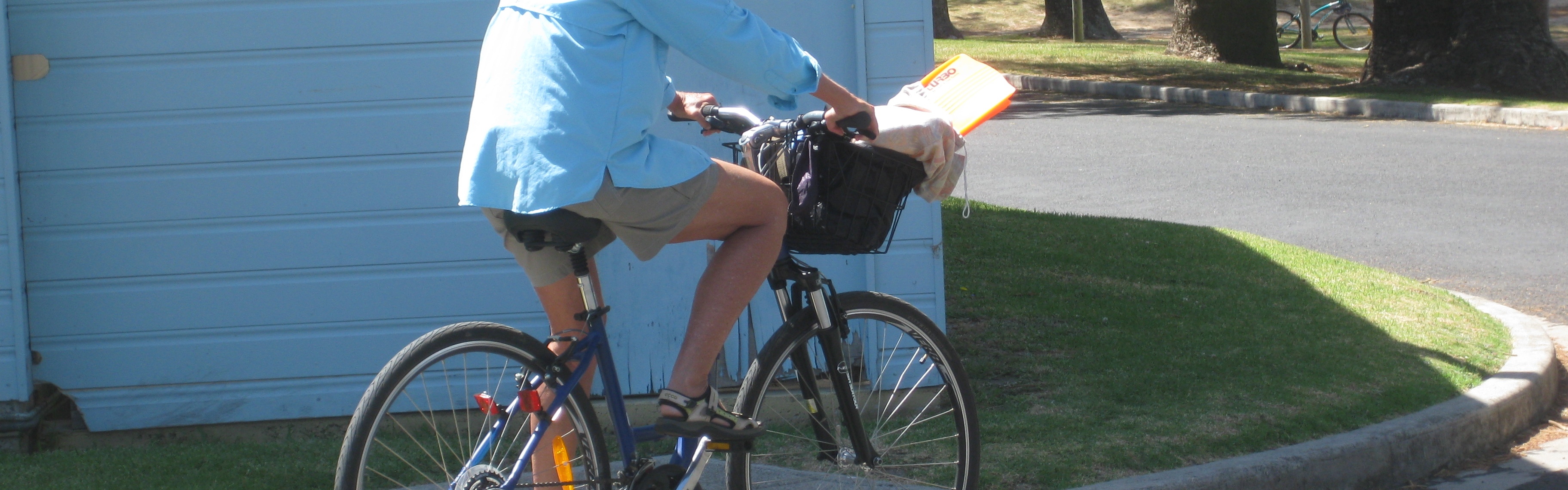

My feet feel the cushion of grass, thick, green and shaded by a tall stand of gum trees. It’s lunchtime at Griffith University’s Gold Coast campus, my surrogate workplace for National Ride2Work day, and I’ve made a temporary office on a quiet piece of lawn. A northerly breeze simpers through native leaves, casting a shimmering mosaic, promising a tailwind for the ride home.
Because I work from home, I’ve decided to shadow a bicycle commuter for National Ride2Work Day. Neither of us have ridden to this destination before. The bicycle commuter usually cycles to a tram stop, locks her bike and catches the tram to the university. Cycling all the way to the campus is double the distance.
Our commute started later than planned – 5.45am rather than 5.30am. I’d built in some extra travel time, as I always do, to cater for the unexpected so there was no need to worry. The sun was hidden behind a motley array of clouds, toning its heat to a comfortable warmth but mellowing the buoyant breath of a brand new day. Clear blue skies, sunshine and birdsong always speak in volumes that can’t be ignored. Cloudy days are quieter, moodier perhaps, less evocative to the senses. I was grateful though for the absence of both the rain that fell overnight and the northerly wind that blew for the past two days. A northerly would’ve meant a headwind for most of our 27 kilometres.
Familiar terrain
The first 17 kilometres was familiar terrain – across Tallebudgera Creek, over Burleigh Headland, along Nobby’s Beach esplanade, up to Broadbeach and onto Surfers Paradise with its high-rise towers hugging the beach. On the esplanade at Surfers Paradise, we stopped at the bike commuter breakfast organised by the Gold Coast City Council and Bicycle Queensland. Not to eat, just to say g’day. We had a picnic breakfast packed. I’d made Bircher muesli the night before, mixed it with grated apple and fresh blueberries in the morning, and packed it alongside an ice brick. We ate beneath a pandanus tree on the Surfers Paradise beachfront and enjoyed the view.
The kilometres less travelled.
Then came the kilometres less travelled. On the coastal strip, Surfers Paradise turns into Main Beach and, here, something unexpected happened. We decide to ride on the road for speed – it’s already 7am, the lecturer has to be in class at 8am and we still have ten kilometres to ride. But soon concrete barricades appear, wire fencing, grandstands wearing empty plastic seats and advertising banners for oil, fuel and tyres. We’re riding on the V8 Supercars racetrack!
For a few days in late October the ‘Gold Coast 600’ fills these streets with speeding cars, burning fuel and testosterone. During our bicycle commute, we had the track to ourselves – local car commuters know to avoid this area while the track is being set up each year because there are always traffic delays. Our only delay was trying to work out how to ‘escape’ this tunnel of wire fences and concrete barricades that we’d stumbled into. Did my pace pick up at the thought of being on the soon-to-be racetrack? Perhaps a little.
After a momentary panic about being stuck on this racetrack and the passing of about 600 metres, a gap appeared in the wire fencing and we wheeled over some grass, past the temporary port-a-loos, over a footbridge and into Macintosh Park where ducks and geese fed, and elaborate peacocks made theatrical displays of richly coloured feathers.
More new territory appears.
Then more new territory appears. And it comes in the form of a light rail system; the Gold Coast’s ‘G:link’ tram which opened in July 2014. There are underpasses for crossing the road and overpasses for traversing the river. New to navigate but easy to pedal. The cycle ways are smooth and the signage clear.
Then came the hill we hoped to avoid. We saw it from the top of a crest that dipped down into a gully before rising for a long slow climb.
‘What was that other way you were talking about?’ giving away my apprehension.
Then I reminded myself that hill climbs have a way of looking more daunting than they are. ‘We’ll be halfway up it before we know it.’ And we were. Over the crest, down towards an intersection and then onto a trail through bushland, glistening with moisture from the evening rain and refreshing our cells.
Almost there
Birdsong gave way to sounds of cars speeding along the Smith Street Motorway and the light rail sliding on its tram tracks. We were almost there. One more hill and then the best part of this commute arrived in the form of some superb infrastructure: A bicycle lane, an entry way cut into the kerb for a quick exit from the road and we’re delivered to the Griffith Health Centre where a sign reads ‘End of Trip Facility’.
In this instance, ‘end of trip’ specifically refers to the end of a bicycle commute. Accessed only by staff or student card, the facility provides bike racks and two large change rooms with showers. This type of facility adds to the ease of bicycle commuting and is evidence of an organisation’s genuine commitment to encouraging active travel. I was impressed.
The lecturer arrived in class on time. I went to the coffee shop for inspiration for writing and, after lunch, set up my temporary office here on the lawn.
POSTSCRIPT: The trip home was less eventful and slower. We were both tired, plus the northerly didn’t follow through on its promise of a tailwind. A round trip of 54kms is a long commute pedalling a bicycle. But in the spirit of this experiment and of National Ride2Work day, this commute was about having a go, trying something new and seeing how it fits.
The lecturer’s verdict?
- It’s unlikely to be sustainable as an ‘every day’ commute.
- Weaving it in once a week or once a fortnight is possible.
- The cycle/tram combo is a more realistic option.
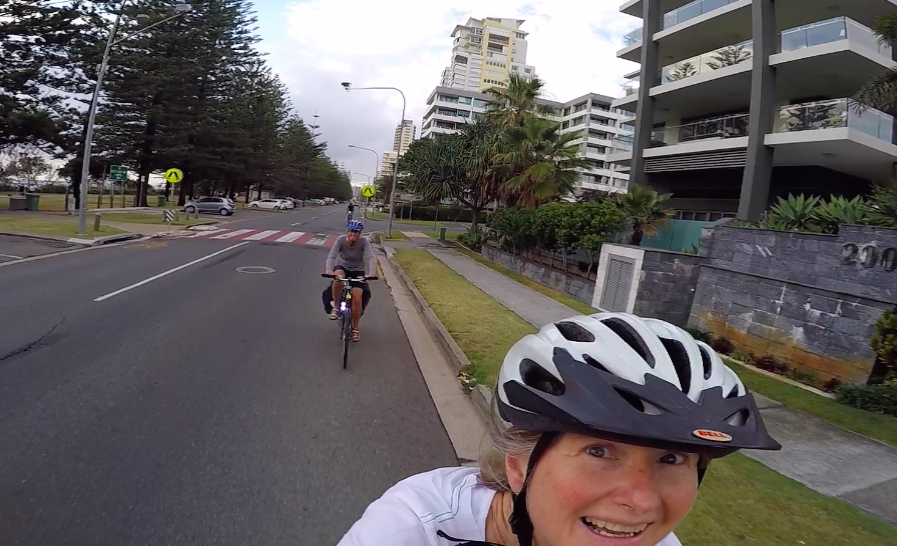
In convoy… travelling by bicycle on National Ride2Work Day.

Dedicated bicycle lane makes commuting easy between Miami and Broadbeach.

Arriving at Surfers Paradise esplanade.
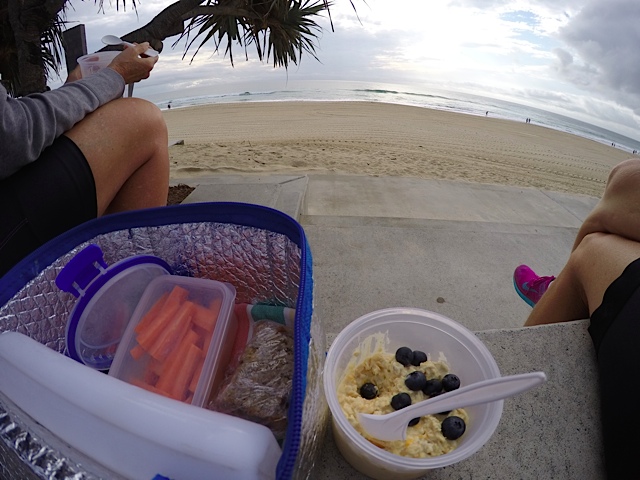
Picnic breakfast by bicycle… with an ocean view.

Trapped on the V8 Supercar Racetrack!

One of the elaborate peacocks with richly coloured feathers.

G:link Tram tracks run beside smooth cycleways.
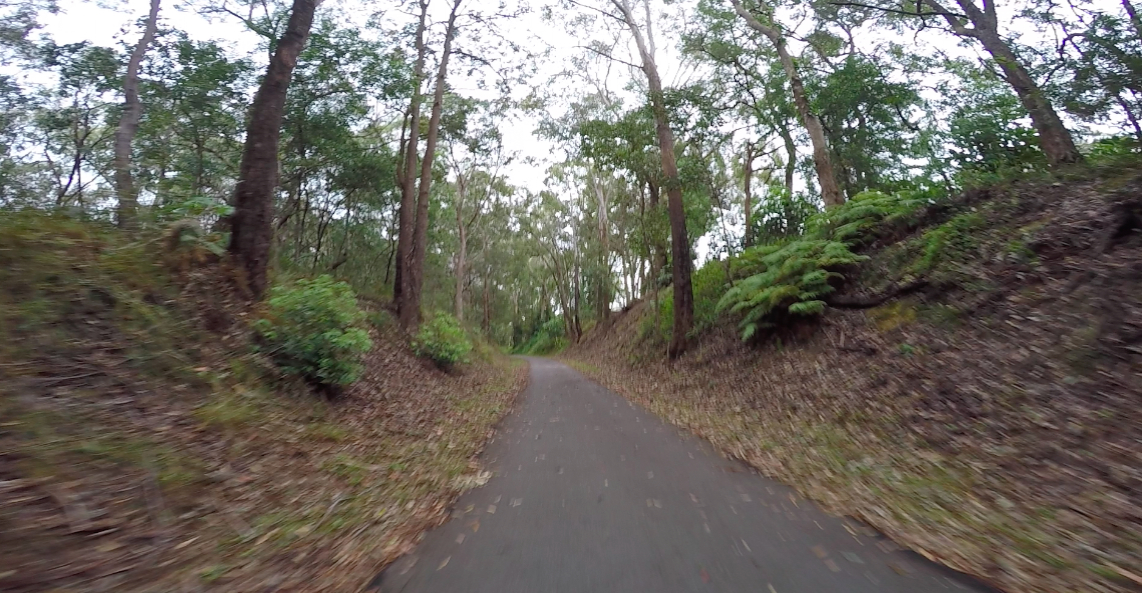
Bushland trail near Griffith University Gold Coast campus.

For visitors to the University/Hospital precinct, this Gold Coast City Council bike shed provides undercover bicycle racks.

My temporary office on a quiet piece of lawn.
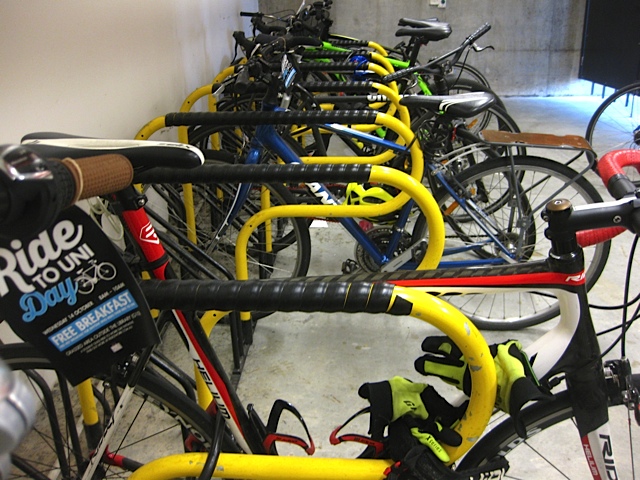
Wednesday was National Ride2Work day where Australians are encouraged to commute to work by bicycle. It’s a wonderful initiative to draw awareness to the possibility of riding a bicycle to work and to give people an opportunity to try it. There are breakfasts organised by local councils and bicycle associations, allowing commuters to meet along the way and share the experience of riding to work.
My workplace is at home. So commuting by bicycle to a workplace isn’t part of my life. I travel by bicycle to meet colleagues as much as I can but a commute to a regular workplace isn’t part of the picture. A friend joked that I could ride around the block to celebrate the occasion of National Ride2Work day. But… I really wanted to somehow join in. So I decided to create a more realistic experience of commuting to a workplace by bicycle. I decided to shadow a bicycle commuter.
This would have been an easy task if I picked someone who lives close to their workplace. But I didn’t. Instead, I was looking at a 27-kilometre commute (16.8miles). One way!
Commuting by bicycle needs a little bit of planning.
Commuting by bicycle needs a little bit of planning. In some very strange way, it reduces to food, shelter and water, plus direction.
When am I going to eat? Before I leave home? Along the way? At work? What food will I need during the day, given the ride will increase my body’s metabolic rate.
Planning for shelter is about what I’ll wear. Will it be hot, cold, windy, wet? Can I wear my clothes for the destination? Or will lycra cycling pants be more comfortable? Where can I get changed when I get there? What facilities are at my destination for that? What do I need to carry with me and how will I carry it? Backpack? Panniers? Basket?
Plus I’ll need to pack water for staying hydrated – and then keep hydrating. I’m sipping coconut water as I write this post. It’s a good source of potassium and magnesium for rehydrating.
Finally, what direction will I ride? What cycle ways and bike lanes exist? How can I avoid heavy road traffic, difficult intersections and hills! The answers to these questions will be as individual as each commuter. And although it seems like a lot to consider, once those questions are answered, it becomes easier. I commuted by bicycle for a few years when working at Southern Cross University, about 13kms away. It became a familiar rhythm to my working life and one that I enjoyed.
How long will the ride take?
Once I know my direction, I also need to work out how much time to allow. I use Google Maps, which has a bicycle transport option, to determine the distance. The other tool I use is a CatEye speedometer. It tells me statistics about my riding (there might be Smartphone apps for doing the same). The statistic I use here is my average speed. With it, I can calculate how long the ride will take me. So, knowing my typical average speed is 15kms/hr (when carrying a full pannier), the 27-kilometre commute is going to take about one and half hours.
So that tells me when I need to leave home. But how will I know if I’m ‘on time’ along the way? That’s where I use the CatEye again to keep my average speed at 15kms/hr (9.3mph) or more.
So with the planning done, the alarm was set for a 5.30am departure.
I was looking forward to the experience but not without some concern about the distance and the deadline of ensuring the bicycle commuter could be there for her 8am start. You see, this was the first time I’d ridden to this destination. It was also the first time for the bicycle commuter herself!
To be continued...
National Ride2Work day is an initiative of Bicycle Network that takes place annually.

Many local government authorities provide cycling maps to help with planning.
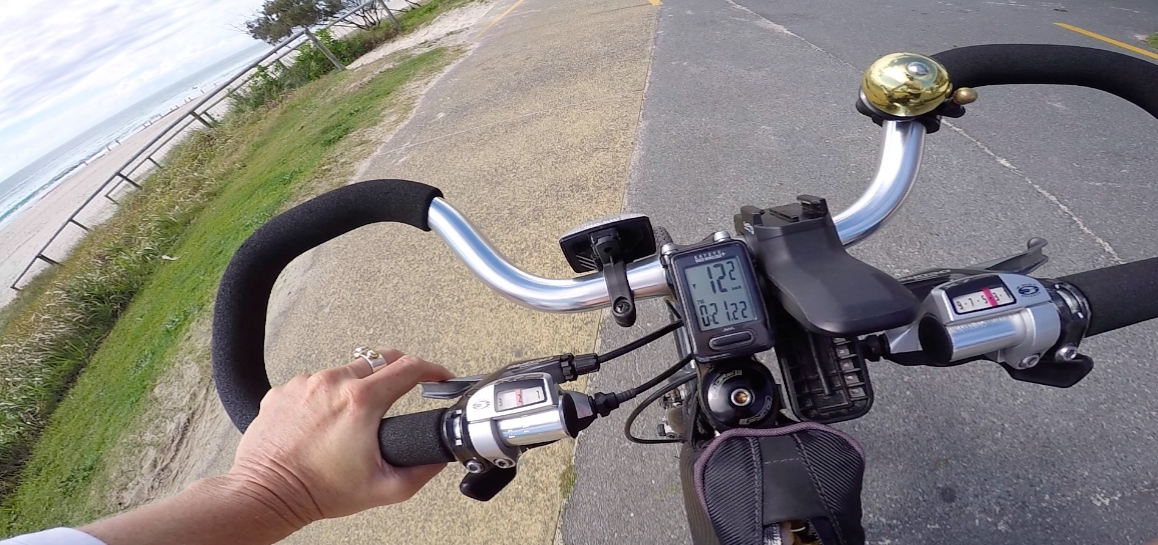
The CatEye speedometer sits at the centre of my handlebars, telling me my riding speed, time and distance.

My yellow pannier for carrying things. It’s waterproof and I have one for each side of the bike.

Bikes racing, at high speed, lightweight frames, skinny tyres and bodies fully-kitted in lycra. It’s not the type of bike-riding that I do. In fact, it’s quite the opposite to the slow, leisurely rides on my touring bike’s sturdy frame bearing stable tyres and weighty pannier bags, with me donning ‘dress for my destination’ clothing. Yet, as different as racing bikes are, I quite like watching them. And this weekend, I had the opportunity to watch some fantastic racing right on my doorstep.
Yesterday on the Gold Coast, the inaugural Kirra Criterium was held. In bike racing, a criterium is a short course race that involves multiple laps around a defined circuit. For the Kirra Criterium, a 1.2 kilometre circuit was created on the Kirra Beach esplanade along Musgrave Street. And from 8am the racing started.
Each race involved a fixed time of riding plus two laps. For example, cyclists in the Open Women category, raced around the circuit for 30 minutes and then were told there are two laps to race. On the final lap, a bell is rung, the speed kicks up and the excitement builds!
The criterium requires stamina and speed. The riders fly past as a blur. The only place they slow down is at the turnaround at each end of the circuit. With my tiny GoPro camera designed to capture fast movement, I explored a few different vantage points. One of them was a turnaround point where I saw a professional photographer crouching down to catch a front shot of the cyclists as they approached the turnaround.
He beckoned me over and said: line your camera up with the white line (on the road)… even put your camera on the line. So I did. And then eyeballed the cyclists as they hurtled towards us before turning. I learnt a little bit more about photography yesterday thanks Peter Hamilton Mills. People who excel at what they do are always the most generous at sharing their knowledge.
So the three categories raced, the crowds cheered and the skinny tyres went at a speed far faster than I’d ever want to ride. But does it matter what type of bike we ride or clothes we wear or speed we travel? Not to me – just get onya bike 🙂

“Line your camera up with the white line… “
 a bike for all seasons