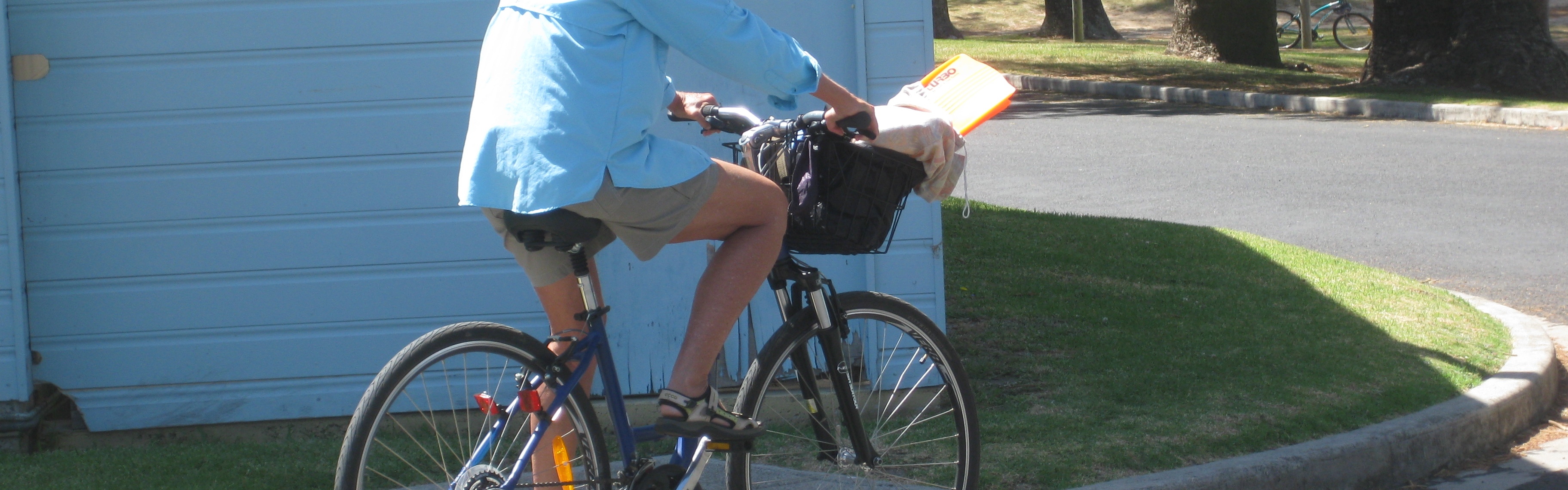

For about ten days each year, the Currumbin Beach esplanade transforms into a sculpture park, alive and brimming with creative juices. The foreshore grass, trees, sand dunes and the sentinel-like rocks that book-end Currumbin Beach provide the landscape for around 55 sculptures to stand, sit, hang, chime, swing or wheel around.
And that’s what I saw when I was out riding today.
Today it was installation day for the Swell Sculpture Festival. Artists combined with trucks, cranes, shovels and many helping hands to set up their exhibits in preparation for the festival starting on this Friday, 11th September. It runs through to Sunday 20th September.
From what I saw today, it looks like a great festival is in the making with amazing exhibits and sparkling Spring skies.
And of course riding your bicycle is a great way to get to Swell. So, to inspire…
Here’s a peek of “Wheelie Windy” by artist Ged McCormick – A wind farm made of recycled bicycle wheels – which of course places it right at the heart of abike4allseasons 🙂

Remember the serenity of the signs of Spring that I wrote about in my last post? The buoyant awakening of life and leaf as the weather warms. The sweet scent of blossoms melding and perfuming the air.
Well let me tell you about the sound of ‘CLACK CLACK!’
To which, heads duck, pedals spin faster and serenity flees.
That’s right Spring also means Magpie season.
The Australian Magpie sings a beautiful warble that melts hearts. With the same beak, it snaps: CLACK CLACK! When it’s Spring and the Magpies are nesting, they become very territorial.
Once you’re in their nesting zone, you’re theirs to shoo.
Humans don’t shoo Magpies. They shoo us. They swoop and swoop and swoop until you’ve left their turf. Bicycle riders, runners, golfers and walkers all fall prey to the Magpie protecting his nest from intruders. And while the Magpie is swooping, he’s clapping his beak – CLACK CLACK – around your head. One Spring, a Magpie clipped my ear and drew blood. Nothing serious but it can be dangerous. They have sharp beaks.
Bicycle riders pursue all types of inventions to ward off the Magpie. Bike helmets covered with zip-ties to create porcupine style spikes. A tall stick bearing a small flag that flies above the rider. Two large eyes painted on the back of the helmet. The Magpie knows them all. My technique is to keep my head down and pedal very fast.
I had a warning last week from the Magpie on the Currumbin Beach esplanade when I parked my bike near the Pandanus tree. Just a friendly swoop to say: ‘hey, we’re getting things ready up in the Norfolk Pine. You better start parking somewhere else’.
If you want to find out about, or let others know, where Magpies are attacking in your neighbourhood, check out the website Magpie Alert. The website told me that our usually chilled esplanade Magpie came good on his promise and attacked a cyclist three days ago.
And for some armchair entertainment, you must watch a fantastic video by Glen Holzl and David Frugal called ‘The Magpie Attack’ (see below). It has some impressive slow motion shots of the Magpie in full wingspread as it brakes just before the rider’s head. It’s well worth viewing.
Safe riding everyone! Keep your head down and pedal fast! 🙂
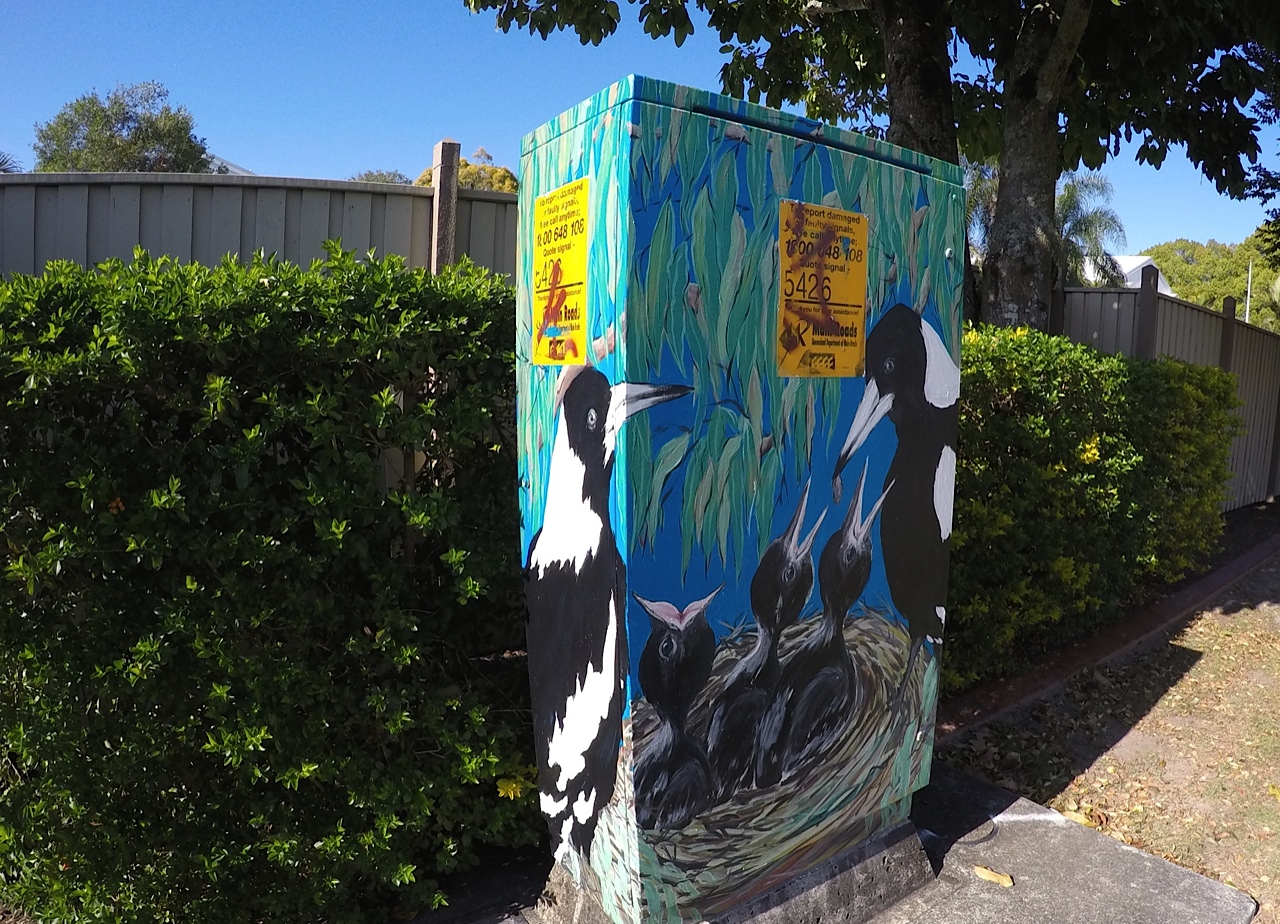
Magpie mural at Currumbin
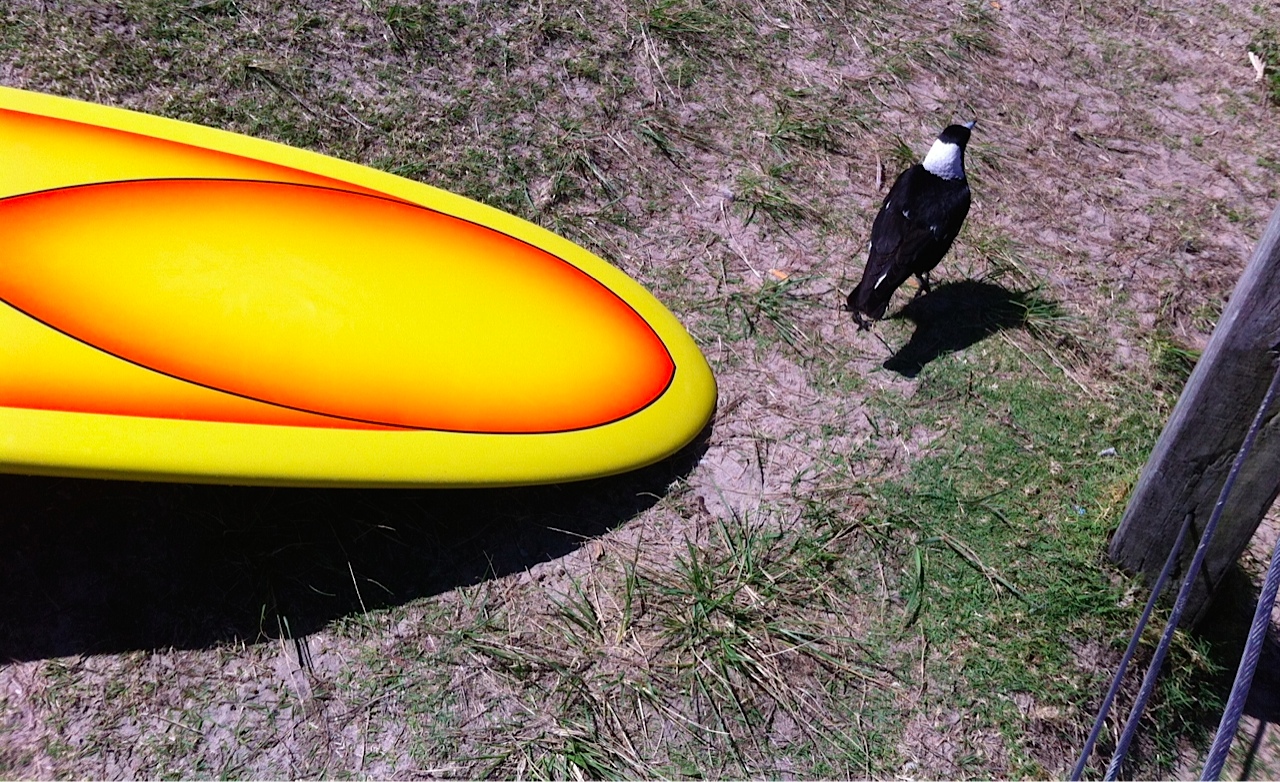
A rather chilled out Magpie at Currumbin Alley strolling past a surfboard.

This post comes with a soundtrack 🙂
Recorded this morning on the second last day of winter as I rode beside Tallebudgera Creek at West Burleigh Heads. You’ll hear the birdsong of Pied Currawongs, Magpies and Rainbow Lorikeets, cars passing by and a plane buzzing overhead.
Yet still the birds sing on, each in their own voice, telling me there are signs of Spring.
You know, when it’s soon to be Spring. Signposts appear that mark the movement into this new season. The land speaks differently across latitudes and longitudes. But everywhere, it speaks.
The leaves of the Jacaranda trees are beginning to yellow. Soon they’ll drop their lace-like frames to the ground, leaving bare grey limbs, ready for purple blooms. They’ll paint brilliant lilac flourishes on tall limbs, stretching into new skies.
The creek mouth narrows where it meets the sea. Winter sands gather and want to move the Currumbin Creek mouth north, but the man-made rock walls resist its flow. So the creek slowly, slowly closes. Soon the sand dredge will arrive to open it again, sucking, pumping, piping and spitting the sand to a new beach.
The Wattle blossoms with their sweet wintery scent are almost spent.
Azaleas begin to bloom.
People start talking about Christmas.
Birds begin to gather threads for their nests. Sticks, string, leaves. This year we found a Noisy Miner, selecting fibres of purple wool from a garment drying on our verandah.
The chip, chip of the first baby birds sounded this week.
And the pair of Wood Ducks that nest each year in our gardens has returned. One year they nested in a planter box on the balcony above ours. When it came time for the chicks to leave, mother duck quacked early one morning from the concrete driveway below. Quack! Quack! Quack! Ducklings lingered on the edge of the concrete planter box, hesitant, teetering, chirping feverishly. Quack! Quack! Mother Duck called. Then a waterfall of ducklings began the descent, free-falling six metres to the pebble-textured concrete. Momentarily, each duckling lay splayed on the ground, then shook, stood and waddled on new legs towards a new life.
And the birds sing on.
Lively sounds of a new season where life expands into its perfect alignment.
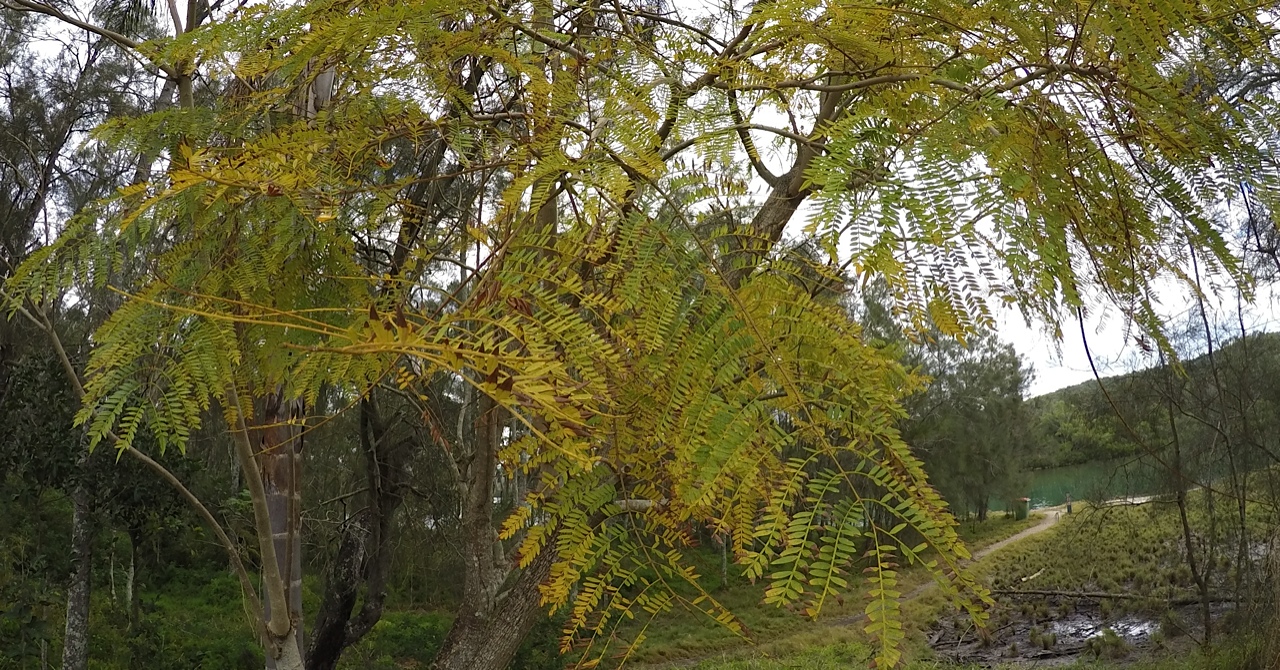
Jacaranda leaves turn yellow preparing for lilac blooms.
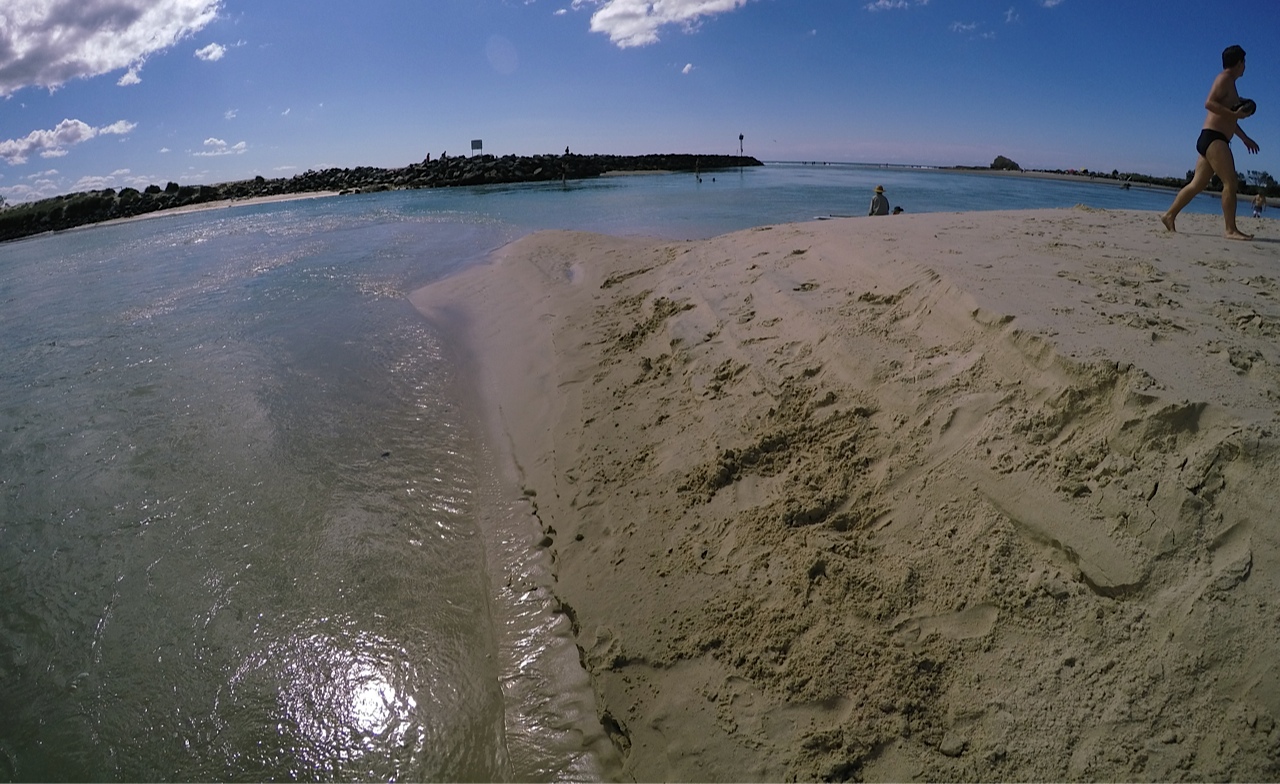
The post’s main photo shows the narrow mouth of Currumbin Creek from a distance. This photo shows the estuary’s narrow mouth from sand level with the man-made rock wall in the background.
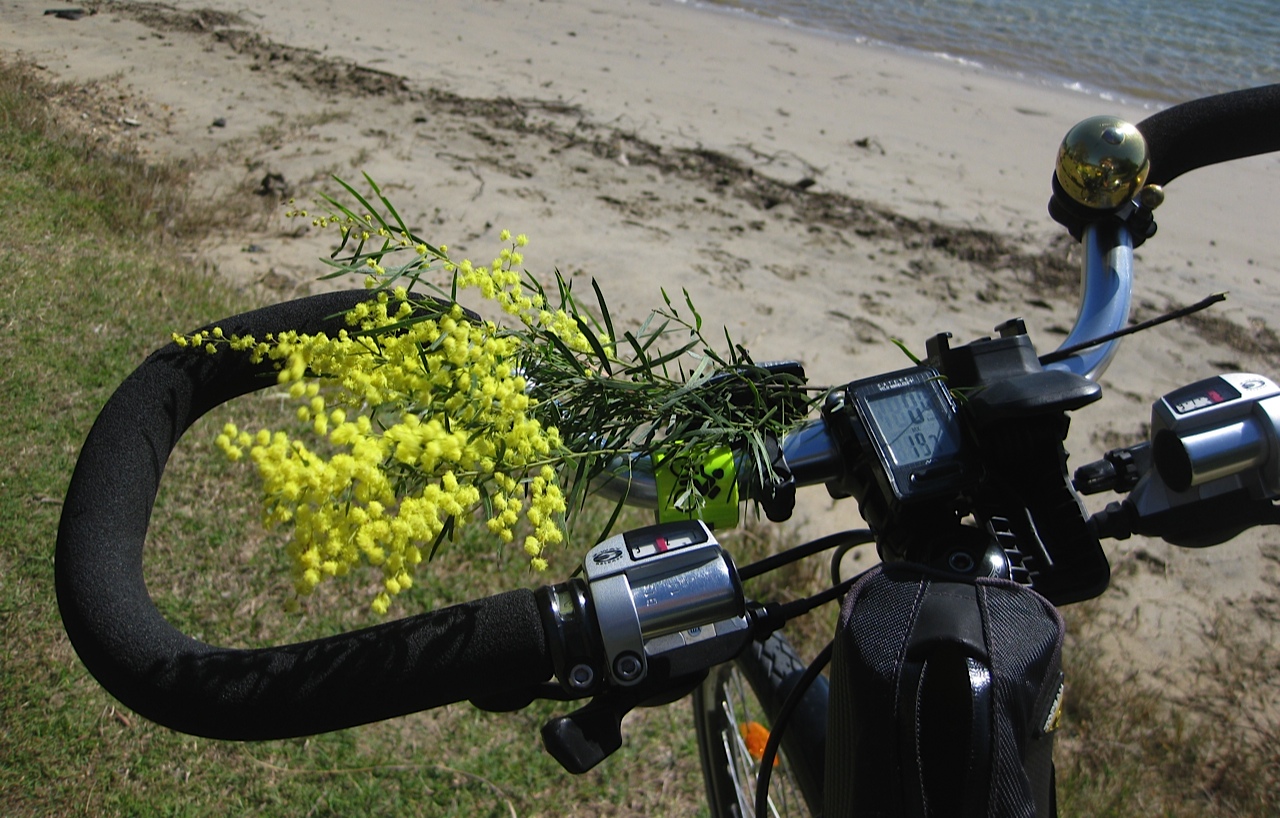
Winter wattle from early August bringing its wintery scent to my handlebars.
FOOTNOTE: The phrase, “the land speaks” is attributed to Jackie French, Senior Australian of the Year for 2015 and author of a wonderful book entitled Let the Land Speak. It is a wonderful interpretation of how the land itself has shaped Australia’s history and why we must listen to it. The book was published by Harper Collins in 2013.
In her acceptance speech as 2015 Senior Australian of the Year…
“We will change the world and it will be extraordinary.”
 a bike for all seasons