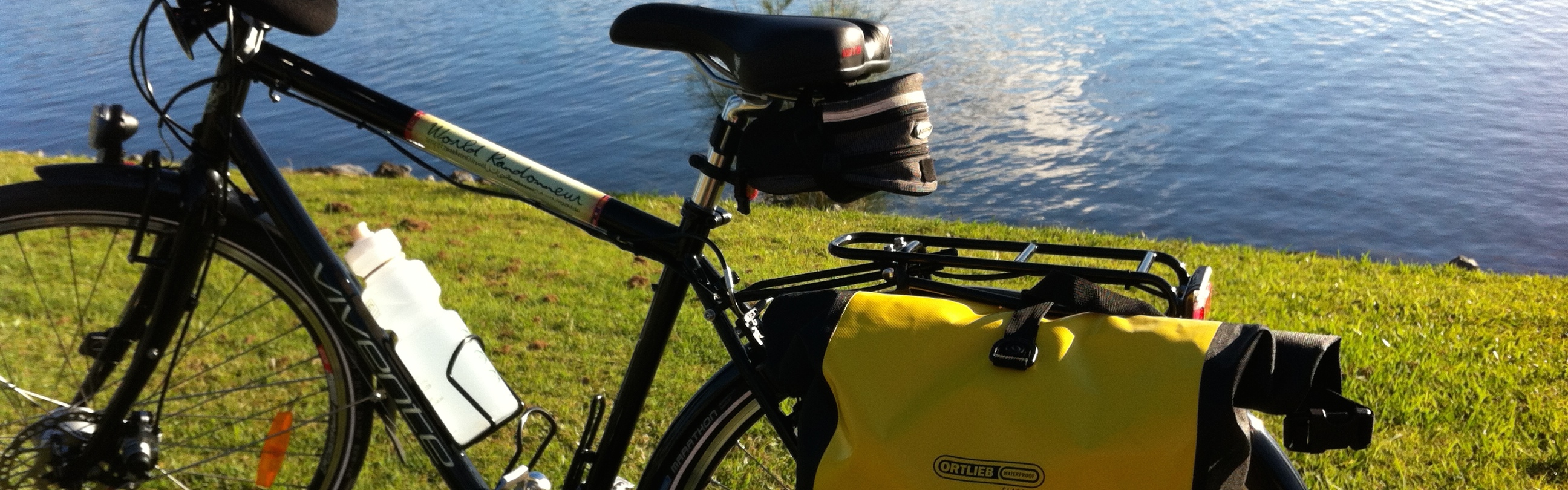
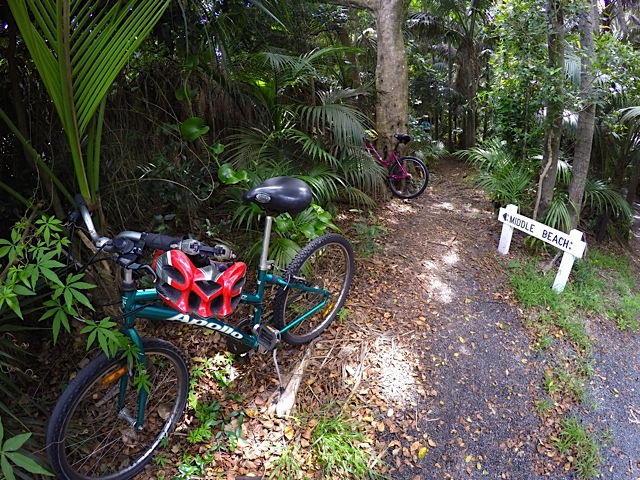
Cars are few. Bikes are plenty. The speed limit is 25km/hour. Most visitors ride bikes. Nobody needs a bike lock. The air is clean. The water is clear and unpolluted.
“Wake up! Wake up! You’re dreaming!” I hear you yell.
And I might have thought the same if I hadn’t seen it for myself.
There is an island, given birth about seven million years ago when lava flowed from a volcano in the Tasman Sea, a sea that shares its shores with Australia and New Zealand. The island is only thirteen kilometres long. At its widest, it is 2.2 kilometres, at its narrowest a mere 500 metres and the island’s highest peak rises to 875 metres, and another to 777 metres. It is the remains of a once large volcanic caldera. And last week I cycled my way through seven days on this island paradise of Lord Howe Island.
Travel two hours by plane from Sydney or Brisbane and this unique island sets an inspiring standard for sustainable living. Lord Howe Island (LHI) is a UNESCO World Heritage area. Being 600kms from the nearest landmass, it has extraordinary land and marine ecosystems. It has the world’s most southern coral reef. Its marine waters have spectacular biodiversity. About 75% of the island’s original natural vegetation is intact. Nearly half of the indigenous plant species are found nowhere else in the world. And, because of its unique system for self-governance, the island residents are able to care, control and manage their island home. Sustainability is a priority and seen as a necessity.

In the distance, Mt Gower and Mt Lidgbird with a lagoon of turquoise waters at their feet.
Bike-riding is part of this picture. Tourist beds on LHI are limited to 400. Roads are few. Cars are expensive to ship to the island and fuel is very expensive. Visitors have to move around and so the bike hire service flourishes. This was my second visit to LHI and this year I noticed a few electric golf carts enabling some elderly people to enjoy the island. Most people, however, ride a bike, hiring it for their entire stay and using it to move from their accommodation to the lagoon boatsheds for a turtle tour to North Bay, to the start of a hiking trail that winds through the island’s nooks, ridges and peaks; and to park it at Ned’s beach while they snorkel amongst corals pink, purple, blue, green, soft, hard, and swim with the elaborately tinted Wrasse, the graceful Butterflyfish, and the curious Silver Drummer fish.

Elaborately tinted Wrasse cruising the coral.
You’re unlikely to see any lycra sitting on the bike seats – just shorts, sarongs, bikinis, and towels worn around wet bathers. Every bike wears a basket that carries the day’s essential kit – beach towel, hat, snacks, water, snorkelling mask, snorkel and flippers or perhaps a map for rambling a trail. No one carries a bike lock. It’s not necessary. Just park your bike and it’ll be there when you return. Each destination – a beach, the start of a trail, the lagoon, the place you sleep, the places you eat – all have a simple bike rack to house your bike. And if there’s no bike rack just lean it against the trunk of a Kentia Palm or in any random location. It’ll be there when you get back.
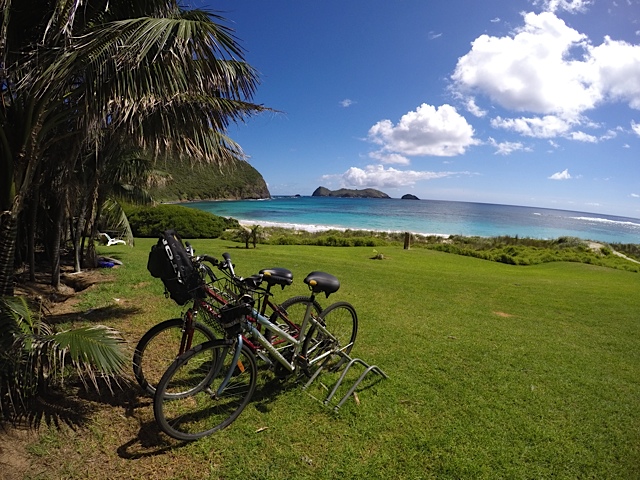
Bike rack at Ned’s Beach.
Cycling is not just for the island’s visitors. Many locals make their way through each day on two wheels. Collecting their mail from the post office, buying their supplies, or to write on the noticeboard after the fortnightly barge arrives from Port Macquarie: “I have someone’s Vaalia yoghurt. Does anyone have my Bulgarian cheese?” There’s often a plastic milk crate tethered to a local’s bike for carting things around. Though one guy had a trailer attached to his mountain bike and told me he’d moved house three times with that trailer!
Bikes are part of life on Lord Howe Island. They help keep the place pristine and they help visitors enjoy a unique holiday in a unique location. Visitors – all ages, sizes, shapes and experience – travel around on bikes. Some clearly haven’t been on a bike for years. Some like me are adjusting to the feeling of an unfamiliar bike. The one thing we all share though is the infectious happiness from freewheeling on this beautiful island paradise.
(p.s. I think I may have broken the speed limit a couple of times riding downhill on Anderson Road.)

Bike parking by the lagoon on Lord Howe Island.
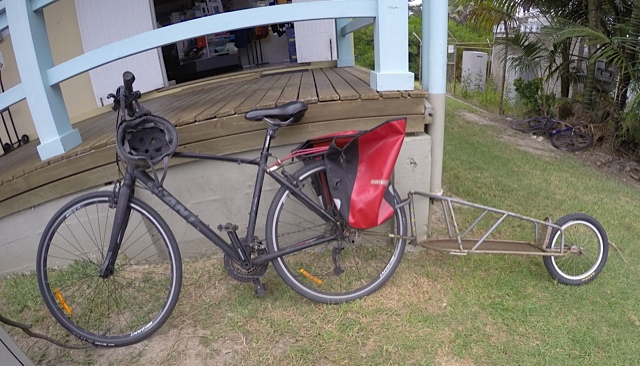
This bike’s owner has moved house three times with this trailer.

Sustainability is essential. The island has to be self-sufficient for its water supply.

The island’s maximum speed limit is 25km/hour.
If you enjoyed this story, click ‘Yes email me new stories‘ and receive my stories straight into your email inbox 🙂 If you know other people who might enjoy it, use the icons below to share it with them on Twitter, Facebook, Pinterest, Google+, LinkedIn or via email. You can also read the About page to find out how this bike riding experiment began and why I’m doing it.

A friend recently visited The Netherlands for a family reunion. Over a few weeks, he travelled to four cities and as a keen photographer (and the owner of a new bike for cycling forest trails), James was captivated by the way in which bicycles are part of everyday life. With James’ permission, here are his observations and photographs:
Netherland Bikes – A way of life for all seasons.
It was so nice to see a country that relies so heavily on bikes as a common mode of transport. Walking the streets, one could hear approaching bikes as, in places, there are fewer cars and hence less road noise; aside from under serviced bike chains, or the clinging of bells to advise pedestrians or the laughter and chatter of approaching cyclists or those on their mobile phones. It is truly a country geared for cycling where if an accident occurs it is usually blamed on the vehicle driver. Bikes of all shapes and sizes were pedalling the streets, all times of the day and night whatever the weather.
It was a sight to behold when you arrived at railway stations; the parked bikes in dedicated Bike Parks – some single height bike park racks, others double height racks and then there is the multi-level bike park.
…my less than three year old second cousin, to the quite elderly still cycle daily and everywhere.
The view in the photograph above shows the railway station of Delft. I panned across to see double store racking for cyclist commuters catching the train to the final destination.
I came across a number of bikes that took my interest; some older models and some new – all the same it was very interesting to see how from the very young such as my less than three year old second cousin, to the quite elderly still cycle daily and everywhere.
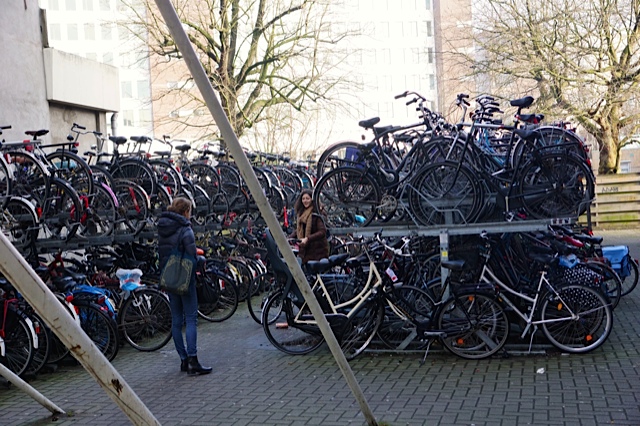
We didn’t quite get to see how the bikes were lowered off the racks or for that matter onto the racks for parking. I should’ve stood around to see how this was done, however it was cold and a hot chocolate beckoned.

A multi-level bike park. FIETS (Dutch for bicycles) is a facility dedicated to bike parking in the busy city of Rotterdam.

Bike hire – an industry in itself. This was one such Bike Hire facility; along side was a huge maintenance workshop.

This cargo bike was later seen carrying two small children snugly tucked under a blanket in the cargo box with Mum pedalling.

An upmarket bike for the family.

Delivery Van or should I say Delivery Peddly.
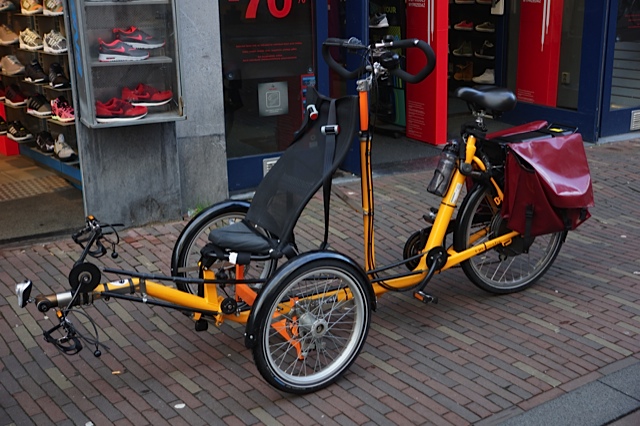
All shapes and sizes – depending who wanted to get to their destination first. (Note from Gail: I showed this photo to another friend who is looking for a Tandem Trike so he and his 98 year old dad can ride together. Wonderful!)
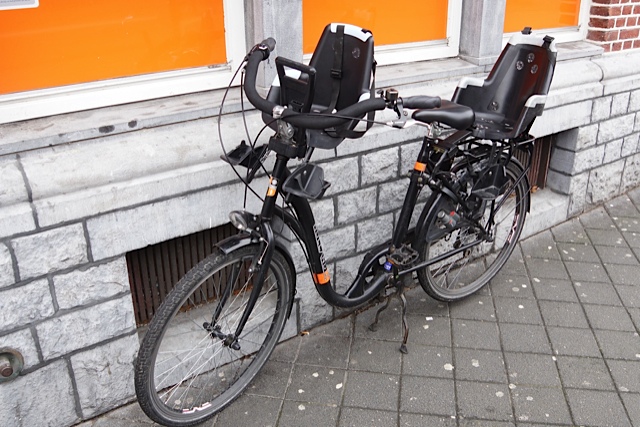
Another one for the family.

A child’s jumpsuit attached to the front seat of the bike with a wind shield for further cold weather protection.

New Ply Sandwich bikes. I did see some bamboo bikes also but wasn’t poised with camera ready to shoot.
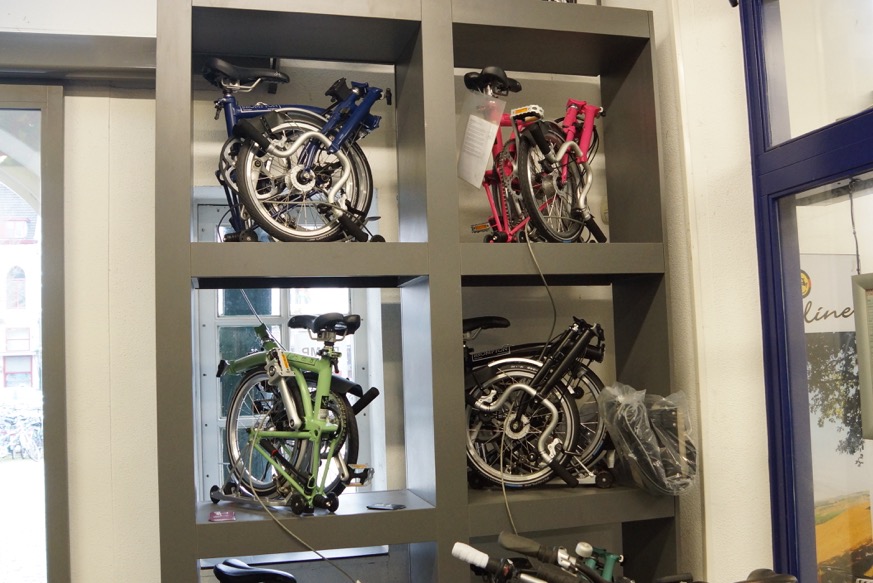
Foldaway bikes

It’s been two months since I started this experiment to ride my bike as much as possible in everyday life. Every good experiment needs some statistics to make sense of what’s happening – at least that’s what the beancounter in me says.
So, I’ve been recording some facts about my bicycle riding: where I rode, why I rode, how far it was, how long I took and, if in the past, I would have used the car.
Here’s a snapshot of some interesting facts from the first two months:
- I rode 668 kilometres.
- About 276 kilometres were to places where I would usually drive the car. There are also car journeys that I chose not to take because it would be too difficult to ride by bike or I decided I wasn’t that motivated to go there after all.
- In a typical week:
- I make about 10 journeys on my bike
- I ride about 75 kilometres
- I spend nearly 6 hours riding my bike.
- I haven’t yet broken my fastest speed of 45.2 km/hour that I reported in my statistics after the first two weeks.
- Holidays and Christmas shopping saw me drive the car a couple of times. So too did my nephew’s beautiful wedding in January at Bargara.
Simply riding around the neighbourhood – for a swim at the beach, to meet with friends for coffee, and to do the shopping – I might ride fifteen or sixteen kilometres across two or three small journeys. I find that quite amazing. By swapping the car for my bike for these short journeys, I’m exercising without even trying!
It’s also saving us some money – which, of course, is making the beancounter in me very happy!
 a bike for all seasons