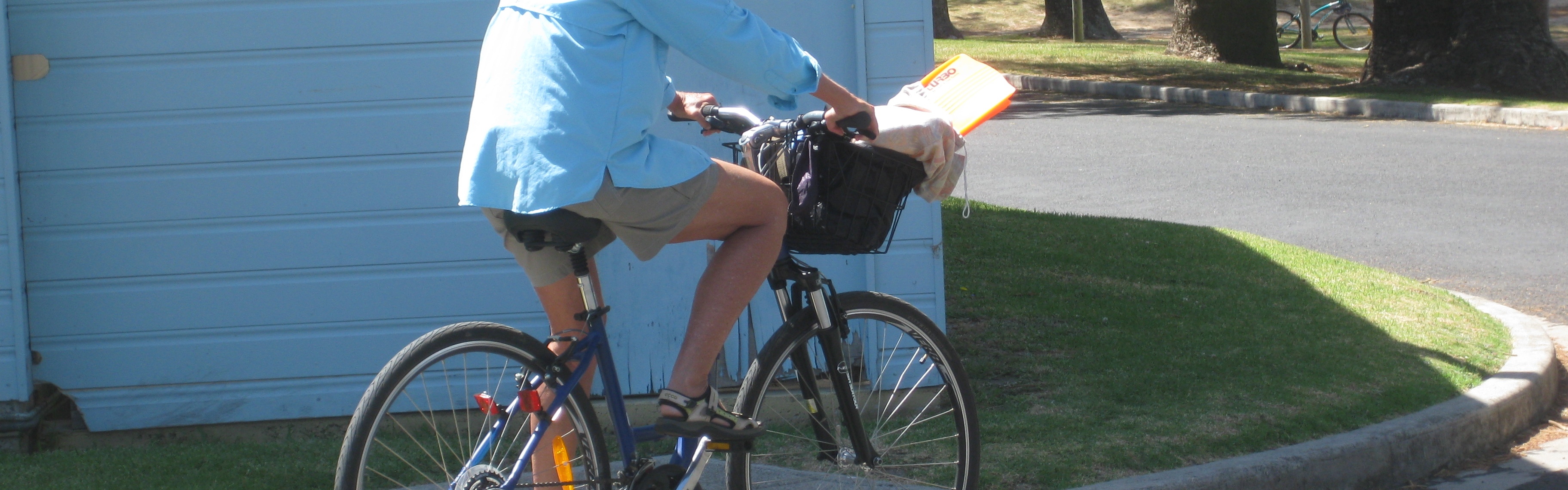

Four days had passed since I’d ridden a bicycle and my feet were getting tired from walking everywhere. Adelaide City is good for walking. The terrain is flat, a feature that also makes it good for cycling. When I first arrived, I hired the Adelaide Free Bikes but, with plans to explore the city’s impressive cycleways, I wanted to ride something that I felt more comfortable on.
Hire bikes come in all shapes and sizes. Some of the best hire bikes I’ve experienced have been those hired from a bike shop. Visiting Gothenburg in 2016, we enjoyed relatively new hybrid bikes hired from a bike shop owner who carefully adjusted each bike for a comfortable fit. They were a pleasure to ride. Visiting Adelaide, I found Treadly Bike Shop and guess what they had for hire? Brompton folding bikes!
I booked a half-day hire via Treadly’s bike hire website for AU$25. The booking process was easy and the website gave good information about the bicycles and places to ride around Adelaide. Treadly’s hire bikes are Brompton M3L models which feature dynamo lights, mudguards, bell, an easily adjustable seat height and the capacity to fold up. Treadly also add a slim front carrier bag, a combination lock, a cool Nutcase™ Metroride Helmet and helpful maps.
For my half-day hire, I decided to ride along the River Torrens. The brown narrow river meanders slowly from the Adelaide hills in the east, through the flat plains of Adelaide city and meets the salty waters of the Gulf St. Vincent. Along its banks runs the River Torrens Linear Park Trail. Until my visit to Adelaide, I’d never heard of linear parks. Researching the term, I learnt they are parks that are longer than they are wide, typically urban and might also be called greenways, parkways, or wildlife corridors.
The River Torrens Linear Park Trail
The River Torrens Linear Park was not only the first linear park developed in Australia, it is also the continent’s largest hills to coast park. From Atheltone in the eastern foothills, the River Torrens Linear Park Trail travels 46.5kms to West Beach. After meeting the river near the Adelaide Zoo, I rode east for about 11kms (if you’re familiar with Adelaide, that took me as far as Darley Road).
Under warm spring sunshine, the bluest of skies, and canopies of river gums, I rode happily, easily and safely along the river’s reedy banks. Occasionally I’d come across some areas under reconstruction which, as I later found out from Treadly Bike Shopowner Sam, was the aftermath of a string of severe storms that struck the city twelve months earlier, producing a state-wide power outage.
At one point I heard a sound that I didn’t recognise. It was unfamiliar. Mechanical like a train yet different. As I rode on, the trail veered away from the riverbank and mirrored a strange road with concrete tracks. I hadn’t seen anything like it before. The sound became louder and then a bus whizzed seamlessly along the tracks. I’d just seen the O-Bahn Busway in action. No traffic to contend with. Express!
After turning around at the Paradise Busway Interchange near Darley Road, I meandered with the river again and came across an interesting community. Lochiel Park is an experimental development with the ambition of creating a ‘green’ village on fifteen hectares. The development is recognised by Josh Byrne (ABC TV Gardening Australia presenter) as a star performer for sustainable lifestyles. Sixty percent of the land is shared green space and the remainder houses 106 dwellings built to exceed the norm in energy and water efficiency. I saw a community garden, water ponds, streetscape sculptures and encouraging path markers for the Lochiel Loop that said ‘woosh!!’ and ‘push!!’ as I rode along.
Returning to Adelaide City, I met bicycle commuters on their way home from work. There were trail-runners padding along too and kids enjoying the playgrounds that dot the linear park. A chocolate milkshake, rowing boats resting and the day closing, I finished my first ride along the Torrens. In two days time, I’d explore some more.
To be continued…
[This post is the second in a series of stories from my visit to Adelaide.]

Good signage along the River Torrens Linear Park Trail.

River crossing
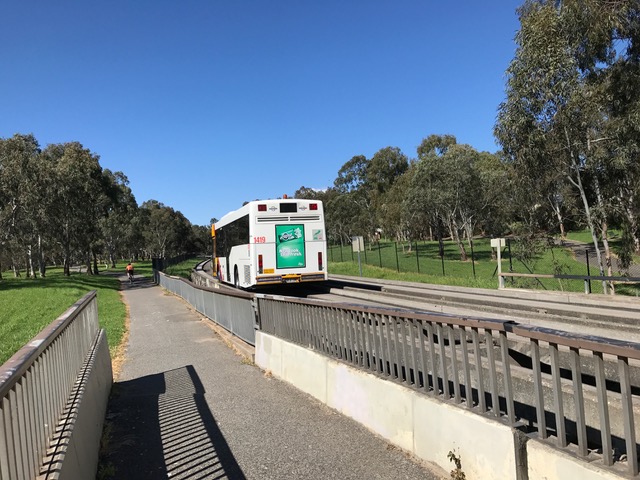
A bus whizzing along the concrete tracks of the O-Bahn Busway.
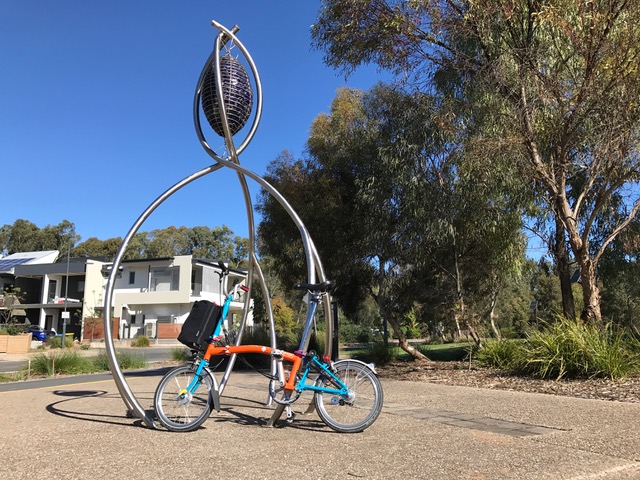
Lochiel Park streetscape

Lochiel Park Community Garden


Lochiel Park signage gave commuting times for walking, cycling or catching a bus as an encouragement to not use the car.
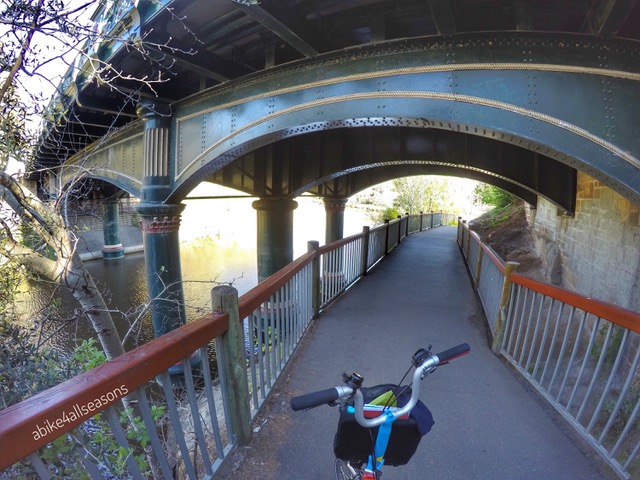
About to ride under Albert Bridge built in 1878.


The view from my chocolate milkshake 🙂

A map of my ride of 28.1 kms with very few hills
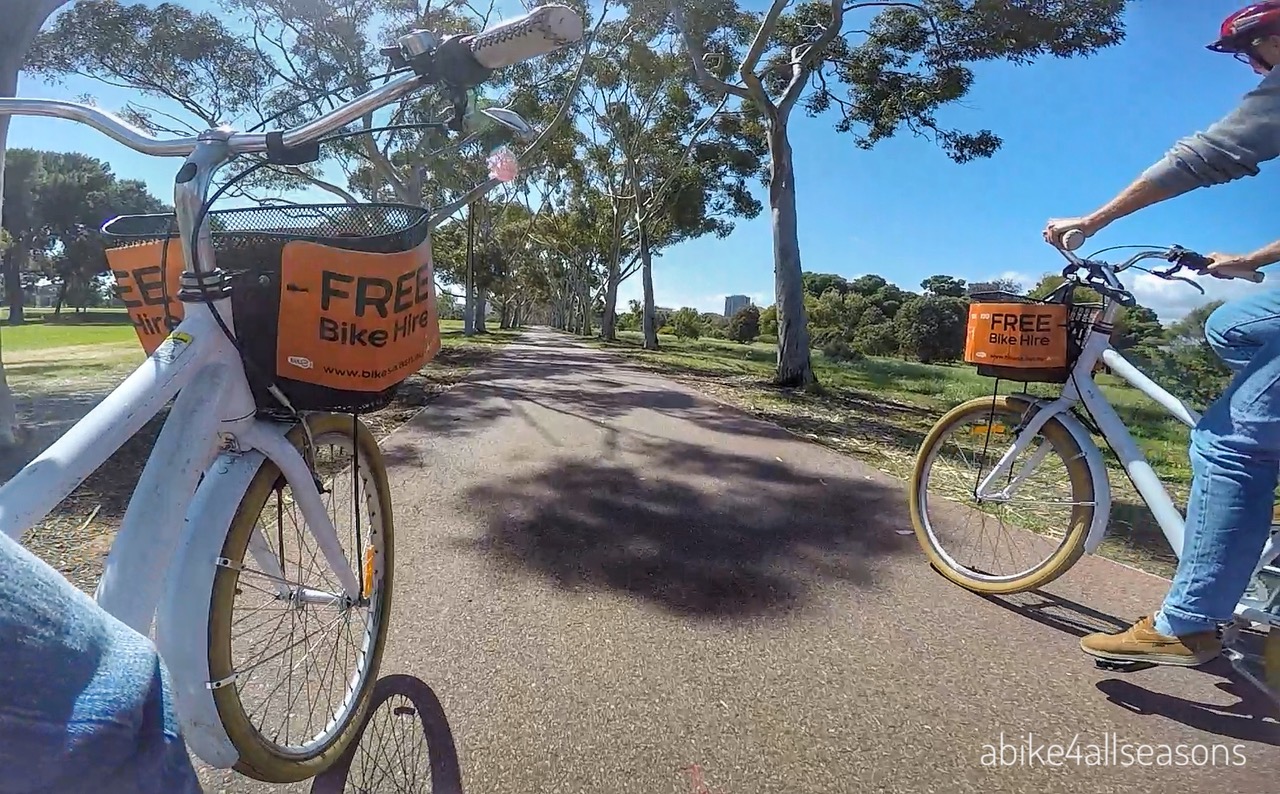
The idea of Free Bikes has an appealing ring to it. Who wouldn’t take a second glance at seeing something they like on offer for free? On a recent visit to Adelaide, without my own bike to ride, I decided to see how this worked.
Adelaide sits on Australia’s southern coastline with a desert to the north and vineyards lining its eastern hills. It is Australia’s fifth most populated city and, like Melbourne, it was settled by Europeans as a colony for free settlers, not as a penal colony like Sydney and Brisbane.
The city rests on the Adelaide Plains beside the River Torrens. Together, the flat terrain and the meandering river, bring easy opportunities for riding. But geography alone won’t make a city good for bike riding. Pathways, bicycle lanes, clear signage and bridges result from organisations – be they government, not-for-profit or corporate – caring about cycling and thinking about how they can create opportunities for people to cycle.
Visiting Adelaide, I was in awe of the integrated network of cycleways throughout the city and beyond. An organisation keenly invested in bringing this together is Bicycle SA, the state’s independent advocate for commuter and recreational cyclists. One of their initiatives is Adelaide Free Bikes, a bike share scheme that gives free access to bicycles.
I’ve written about my experiences with bike share schemes operating in Oslo and Brisbane. Such schemes are growing in popularity as cities attempt to loosen the noose of motor vehicles choking them daily. Each scheme varies in how they function. Both Oslo and Brisbane use a docking system where a fleet of bicycles are ‘docked’ in bike stations throughout the city. In Adelaide, the Free Bikes are typically stationed inside a business, council or tourist building.
These locations house the bikes and, to hire one, you have to provide a valid driver’s licence or passport or Australian proof of age card to an employee at that hire location. After signing paperwork, you can then take a bike and helmet and ride away. You must return the bike that same day during daylight hours to the same hire location and before they close their doors. This is where the system requires a little planning. I found the need to return to the same location more restrictive than a docking system. Also, my selection of a hire location was complicated by each having different days and hours of operation.
I like the idea of Adelaide Free Bikes but the bikes I saw and rode needed maintenance to run well (and a good clean). I also found the helmets provided were very tired. The scheme has been running since 2005. As a famous economist once said, ‘there’s no such thing as a free lunch’. Someone has to pay for this free service and I wonder if charging a small fee would help ensure the equipment on offer stays in good condition. But then maybe I’m just particular about having clean, smooth running bikes and other people wouldn’t be bothered by these things. After all, I did see quite a few people riding the share bikes.
Whatever the case, it’s clear that Adelaide Free Bikes is playing a positive part in a broader and impressive bicycle strategy for this wonderful city.
[This is the first in a series of stories from my visit to Adelaide.]
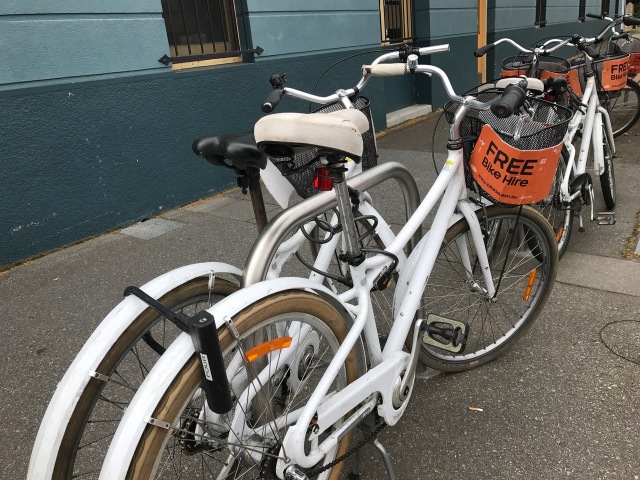
Available Free Bikes outside a backpacker hostel.


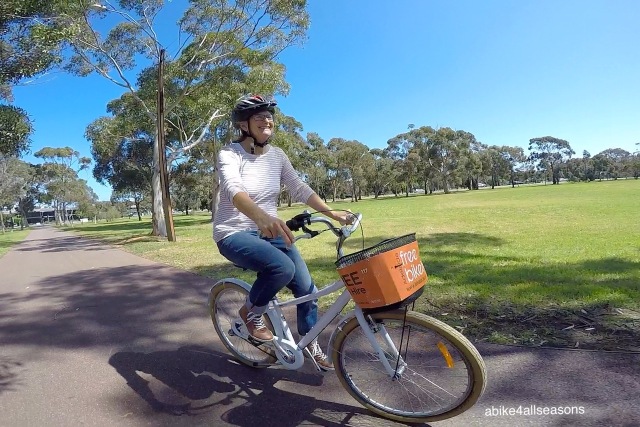
Freewheeling on one of Adelaide’s many park trails.

Four days of riding my bike with little else to think about. Days warmed with spring sunshine and draped with landscapes that stretch the eye to where earth and sky shimmer as one. Night skies aglow with moonlight carrying the sounds of weary bodies sleeping. Sleep, Eat, Ride, Eat, and Repeat. This was my first ‘Cycle Queensland’ Adventure Tour and it ensured my spring began with a most enjoyable ride.
Cycle Queensland is an annual event run by the not-for-profit bicycle advocacy organization, Bicycle Queensland. Each year, the tour takes a different route delivering about 500 cyclists a nine-day cycling holiday. This year’s ride started inland at Goondiwindi, a small town in Western Queensland, and ended at Currumbin Beach on the Southern Gold Coast, where I live.
Two things attracted me to riding the 2017 route. One was that the tour would finish where I live and there was something strangely appealing about the thought of riding home. The other attraction was the route would take us over ‘Tomewin’, a road that connects the Tweed and Currumbin Valleys, and bears a challenging climb that I’d long wanted to try. For similar reasons, Jane decided to join me for the four days.
Choosing the half-tour option, my Cycle Queensland (CQ) began in Stanthorpe known best for apples, wine and cooler climes due to its elevation of 811 metres. Our bikes had been serviced and boxed by our local bike shop, and then transported by truck under the guidance of Bicycle Queensland. After a bus and train ride to Brisbane, we caught a bus to Stanthorpe chartered by Bicycle Queensland.
When we arrived in Stanthorpe, the CQ campsite was chilled, both in mood and temperature. The full-tour riders were relaxed having enjoyed a rest day after riding four days from Goondiwindi to Stanthorpe. Plus, an icy southwesterly was whipping across the campground. After registering at HQ, finding our bike boxes, assembling our bikes and sorting the night’s accommodation, we were ready for the nightly pre-ride briefing at 6.30pm.
Splashed with bellbirds ringing…
Our first day of riding took us from Stanthorpe to Woodenbong along roads lined with gum trees, dotted with granite boulders and splashed with bellbirds ringing. It was also the route’s longest day. Riding a distance of 105.4 kilometres, I experienced my first ever century-plus ride. And survived! Thanks to morning tea at a lavender farm with freshly made lavender scones served with jam and cream, and a healthy tailwind throughout the day.
Day Two brought an icy greeting with sub-zero temperatures overnight. Ice had formed on our tent, bike handlebars, tyres and bike bags. I was glad to be up and eating, and even happier once we started riding and generating warmth. Our second day ended in Kyogle after 60.5kms among bushland chiming with Bellbirds and beside pastured paddocks thirsty for rain.
I know you now…
Climbing rolling hills featured in the route from Kyogle to Murwillumbah on Day Three. Along winding roads with views of Wollumbin coming ever closer, we entered the Tweed Caldera having ridden 1059 metres elevation over the 76.8 kilometre ride. However, rolling hills bring a reprieve. You climb then you descend, then you climb again, and descend. Climbing Tomewin on the following day brought a different story.
With Tomewin, you climb and climb. For five kilometres, you climb, with no downhill reprieve. Yet ascending Tomewin on our final day brought my personal highlight. The climb was harder than I’d expected and more rewarding too. Rolling over the top of the range at the NSW/Queensland border and descending into Currumbin Valley, I felt the exhilaration of having looked an aspiration in the eye and being able to say, I know you now.
A quiet space descends…
Although there might be hundreds of riders participating in this tour, I found a quietness riding along that stands in stark contrast to city riding. In a wide landscape with few cars, the sounds of wind rustling trees and grasses, punctuated with the calls of magpies, galahs and cockatoos, are all there is to hear. A quiet space descends. As I sweep downhill, as I climb steadily up the hills, something quiet lands within. Perhaps it’s the simplicity of travelling by bicycle. Perhaps it’s the closeness to the elements as they touch my senses. Whatever the source, this quiet is a feeling I enjoy.
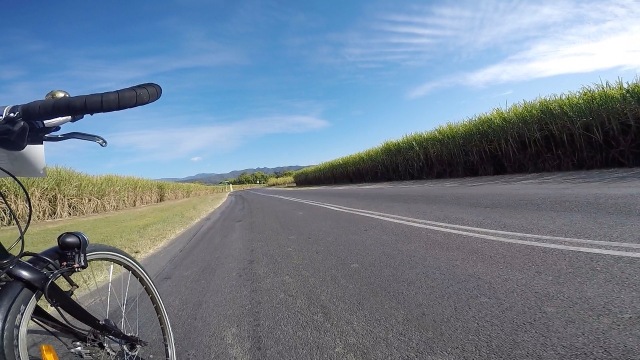


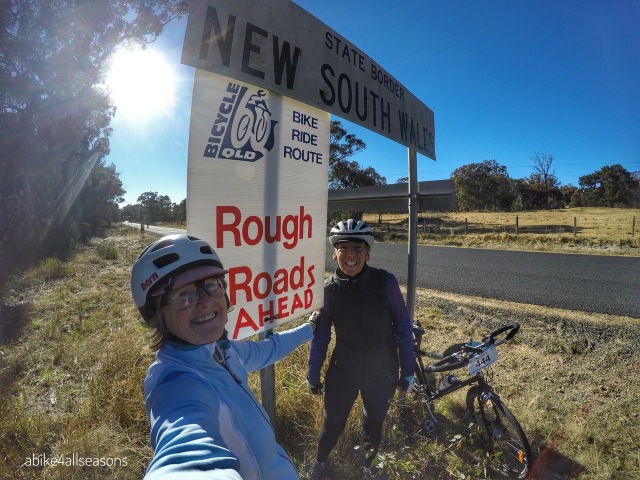
Crossing the NSW border on the way to Woodenbong.

Lavender Farm for morning tea

We had a couple of gravel sections on the road to Woodenbong.

Paddocks dry and skies blue.

Ice on every surface of my bike!
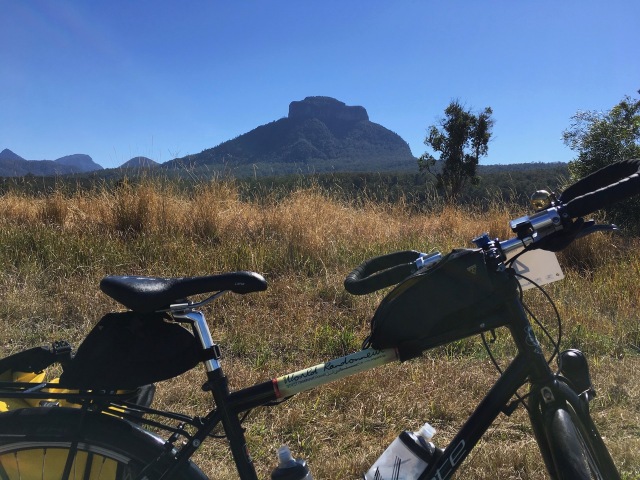
Mt. Barney was a backdrop for our ride to Kyogle.

Grasses in a wide landscape.
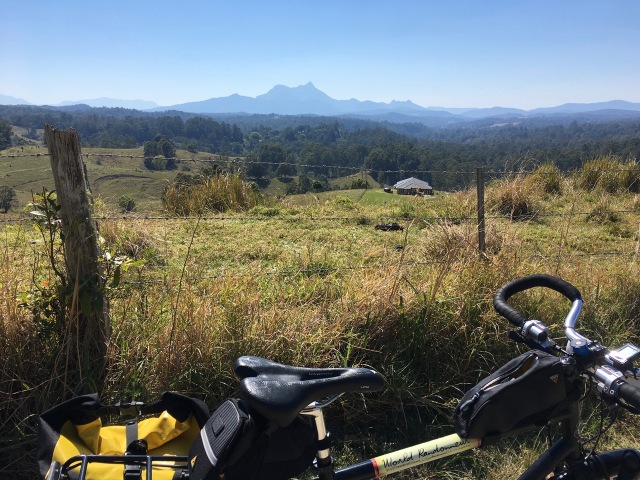
Wollumbin coming every closer.

On the outskirts of Murwillumbah, we stopped at the old railway stop of Stokers Siding.

Campsite at Murwillumbah Showgrounds with Wollumbin in the background.

Canefield-lined roads as we leave Murwillumbah through the Tweed Valley.

Climbing up Tomewin.
 a bike for all seasons